
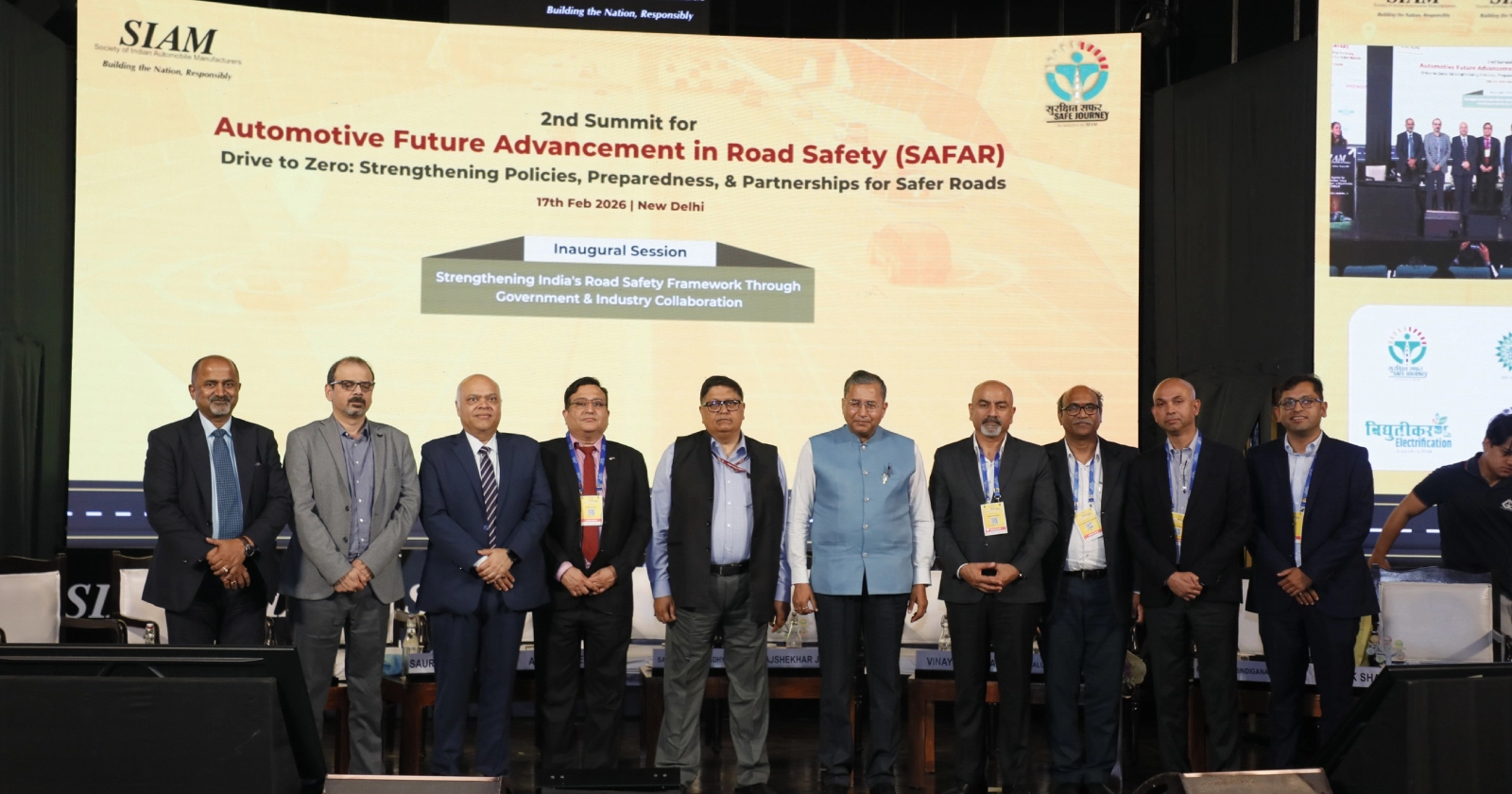
The summit emphasised the role of ADAS, driver monitoring systems, and AI-driven analytics as essential technologies for preventing accidents and enhancing road safety outcomes.


Share Post
The summit emphasised the role of ADAS, driver monitoring systems, and AI-driven analytics as essential technologies for preventing accidents and enhancing road safety outcomes.
The Society of Indian Automobile Manufacturers (SIAM) convened the second edition of the Summit on Automotive Future Advancement in Road Safety (SAFAR) on February 17, 2026, in New Delhi, issuing a strong call for coordinated action to reduce road fatalities across India.
Held under the theme “Drive to Zero: Strengthening Policies, Preparedness, and Partnerships,” the summit forms one of the key pillars of the ongoing SIAM Sustainable Mobility Week 2026, a four-day initiative aimed at advancing safety, sustainability, and innovation in the mobility ecosystem.
Running from February 16 to 19, the initiative brings together policymakers, industry leaders, emergency care experts, OEMs, NGOs, and civil society representatives to address critical challenges in road safety, post-crash care, decarbonisation, circularity, and material compliance. The summit served as a collaborative platform to align national priorities with global road safety targets.
Alongside conference sessions, the Sustainable Mobility Zone offered live demonstrations of next-generation vehicle platforms, advanced safety systems, alternative fuels, and enabling infrastructure. The showcase highlighted real-world innovations designed to make mobility cleaner, safer, and more efficient.
Also READ: PM Rahat Cashless Scheme Introduced; Victims Get ₹1.5 Lakh Aid Now
The inaugural session emphasised the importance of policy alignment and cross-sector collaboration in strengthening India’s road safety framework. Chief Guest Dr. Rajshekhar Joshi, Vice Chairman, Sethu Aayog, Uttarakhand, underscored the need for a mission-oriented approach that integrates education, AI-based black spot identification, and digital awareness campaigns to reduce accidents.
Guest of Honour Sanjay Bandopadhyaya, Member, Supreme Court Committee on Road Safety, highlighted enforcement and inter-agency coordination as critical factors. He said, “Police, health, transport and insurance authorities must work together to strengthen implementation. The Government of India’s zero-fatality programme across 100 districts and financial support for victims, along with the integration of AI-based safety measures, can significantly improve outcomes.”
India records nearly 4.8 lakh road accidents annually, reflecting systemic gaps in infrastructure, enforcement, and user behaviour. Industry leaders stressed that road safety must be treated as a shared responsibility supported by stronger policies, better preparedness, improved road user behaviour, and faster emergency response systems.
Speakers also pointed to behavioural risks such as low helmet and seatbelt usage, particularly rear seatbelts, and the disproportionate involvement of two-wheelers in accidents. Technology-driven licensing systems, awareness campaigns, and stricter enforcement were identified as necessary interventions.
The summit highlighted emerging technologies such as Advanced Driver Assistance Systems (ADAS), driver monitoring systems, and AI-powered analytics as critical tools for accident prevention. AI-led initiatives like iRASTE in Telangana aim to reduce crashes and fatalities by up to 50 percent through integrated infrastructure, mobility, and vehicle safety measures.
Experts also stressed the importance of safer road infrastructure, noting that 10–12 percent of accidents are linked to road design and conditions. Measures such as crash-barrier testing for highways, intelligent traffic management systems, and next-generation city planning were recommended to enhance safety outcomes.
Also READ: AI India Summit 2026: Sona Comstar Showcases AI-Driven Mobility Strategy
A dedicated workshop on post-crash care underscored the importance of trauma response systems and life-saving skills. Medical experts highlighted that delayed care often forces trauma teams into damage-control scenarios, reinforcing the need for faster emergency response and better coordination between healthcare and transport authorities.
During the summit, SIAM also released a context paper titled “Advancing Road Safety Through Systemic Policy Reform,” reinforcing the need for institutional coordination, shared data, and community-focused vehicle technologies. Panel discussions further explored education initiatives, mobility data sharing, and partnership models to build safer transport ecosystems.

Ola Launches Champions Edition S1 Pro+ and Roadster X+
Acko Drive Team 11 Mar, 2026, 12:24 PM IST
Ashok Leyland Breaks Ground on Battery Pack Plant Near Chennai
Acko Drive Team 11 Mar, 2026, 11:45 AM IST
Ather Rizta & 450 Series Electric Scooters Get Special Discounts For March Worth ₹20,000
Acko Drive Team 11 Mar, 2026, 11:41 AM IST
Mercedes-Benz Slapped With Hefty $7.6 Million Fine in South Korea
Acko Drive Team 11 Mar, 2026, 11:06 AM IST
Updated Royal Enfield Guerrilla 450 To Go On Sale By Late March
Acko Drive Team 11 Mar, 2026, 9:51 AM IST

Looking for a new car?
We promise the best car deals and earliest delivery!
