
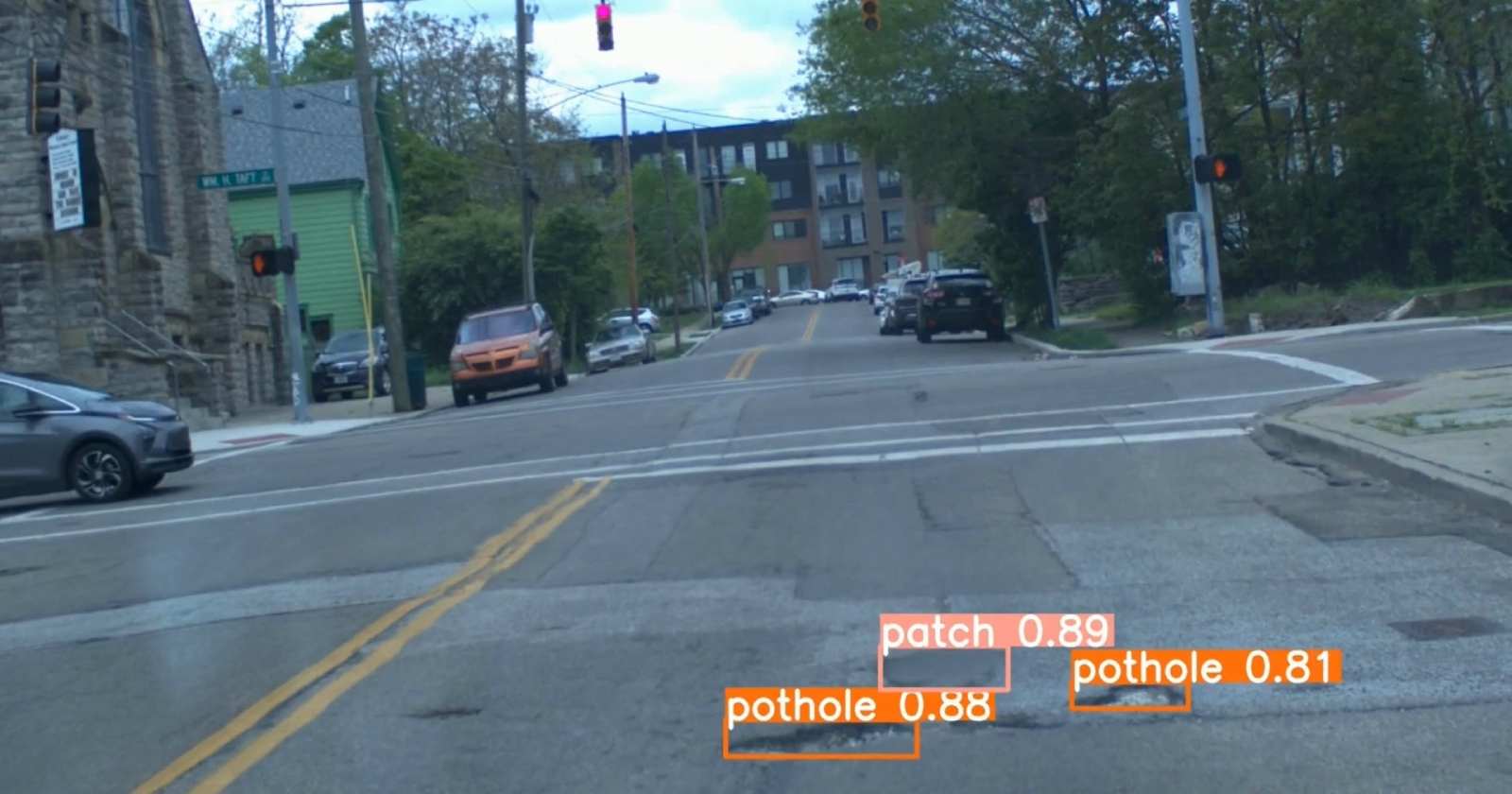
The company says it has achieved 89 percent average accuracy for pothole detection so far, but the AI algorithms can learn from missed detections and improve.


Share Post
The company says it has achieved 89 percent average accuracy for pothole detection so far, but the AI algorithms can learn from missed detections and improve.
Honda, in partnership with the Ohio Department of Transportation (ODOT), has conducted a pilot programme for what it calls the first proactive road maintenance system in the USA. The project aims to show the feasibility of an automated reporting system for road maintenance issues, helping municipal bodies to find and fix problems quicker, reduce costs, and maximise safety.
Using test vehicles outfitted with LiDAR and computer vision sensors, approximately 3,000 miles (4,828 km) of roads across the state of Ohio were examined. Potholes were detected and tagged with size and location information. Other issues that the test vehicles are able to detect include road quality deterioration, faded or insufficient lane markings, worn or obstructed road signs, damaged guardrails or other types of barriers, and road shoulders in poor condition.
The cars are driven in various real-world weather conditions and at different times of day. Various types of roads and geographies have been covered. The Proactive Roadway Maintenance System has been in development since 2021.
Data is processed using AI models on a cloud-based platform. This allows the automatic generation of work orders prioritised by severity and grouped by location, to make repair and maintenance work more streamlined and efficient.
Honda says the pilot achieved accuracy of, on average, 89 percent for pothole detection, 99 percent for damaged or obstructed signs, and 93 percent for damaged guardrails. The system can improve over time by learning from mistakes that the team flags manually. In the future, commercially available cars with similar sensors built in could be capable of gathering such data, which owners could opt in to sharing in order to create a massive, scalable, crowdsourced network of road quality data for local agencies to act on.
The study was conducted by Honda in association with technology partners i-Probe for data validation, along with the University of Cincinnati which helped with sensor integration and damage detection and Parsons Corporation for its roadway asset monitoring platform.
The company hopes to work together with government, industry, and local community partners. Data collected will also help develop ADAS systems in order to improve safety and understand driver behaviour in different conditions and when dealing with deficient infrastructure.

Rajiv Bajaj Calls Maharashtra EV Policy A “Failure”
Acko Drive Team 25 Feb, 2026, 6:01 PM IST
New-Gen Renault Duster India Launch Confirmed On March 17
Acko Drive Team 25 Feb, 2026, 1:22 PM IST
Toyota Land Cruiser & Lexus LX Recalled In India Over Gearbox Software Glitch
Acko Drive Team 25 Feb, 2026, 12:46 PM IST
Jetour T2-Derived SUV Officially Teased by JSW Motors in India
Acko Drive Team 25 Feb, 2026, 12:05 PM IST
Pune May Ban Vehicles Older Than 15 Years
Acko Drive Team 25 Feb, 2026, 11:55 AM IST

Looking for a new car?
We promise the best car deals and earliest delivery!
