Car Headlights: An Overview
Car headlights are essential tools for providing enough light to see the roadway ahead during nighttime driving and/or poor weather conditions. This also helps other drivers see your vehicle, thus decreasing the chance of accidents.
The development of the automobile headlight has produced several types of technology that offer various levels of illumination, as well as energy efficiency and life span. From the economically priced halogen headlight to the advanced laser technology, there is a type that meets the needs of all consumers, regardless of their budget or driving needs.
There are many issues associated with purchasing a headlight, including performance, design, and compatibility with the automotive product.
Why Headlights Matter
Headlights increase the level of safety while enhancing the experience of driving by
- Increasing the ability of the driver to see an obstacle/hazard at night
- Increasing the visibility of a vehicle to other vehicle operators and pedestrians
- Reducing driver fatigue by providing additional lighting
- Meeting legal safety requirements
- Increasing the value and appearance of a vehicle
Main Types of Car Headlight Technologies
Automobiles of the present day utilise a variety of headlight technologies that have their own particular attributes.
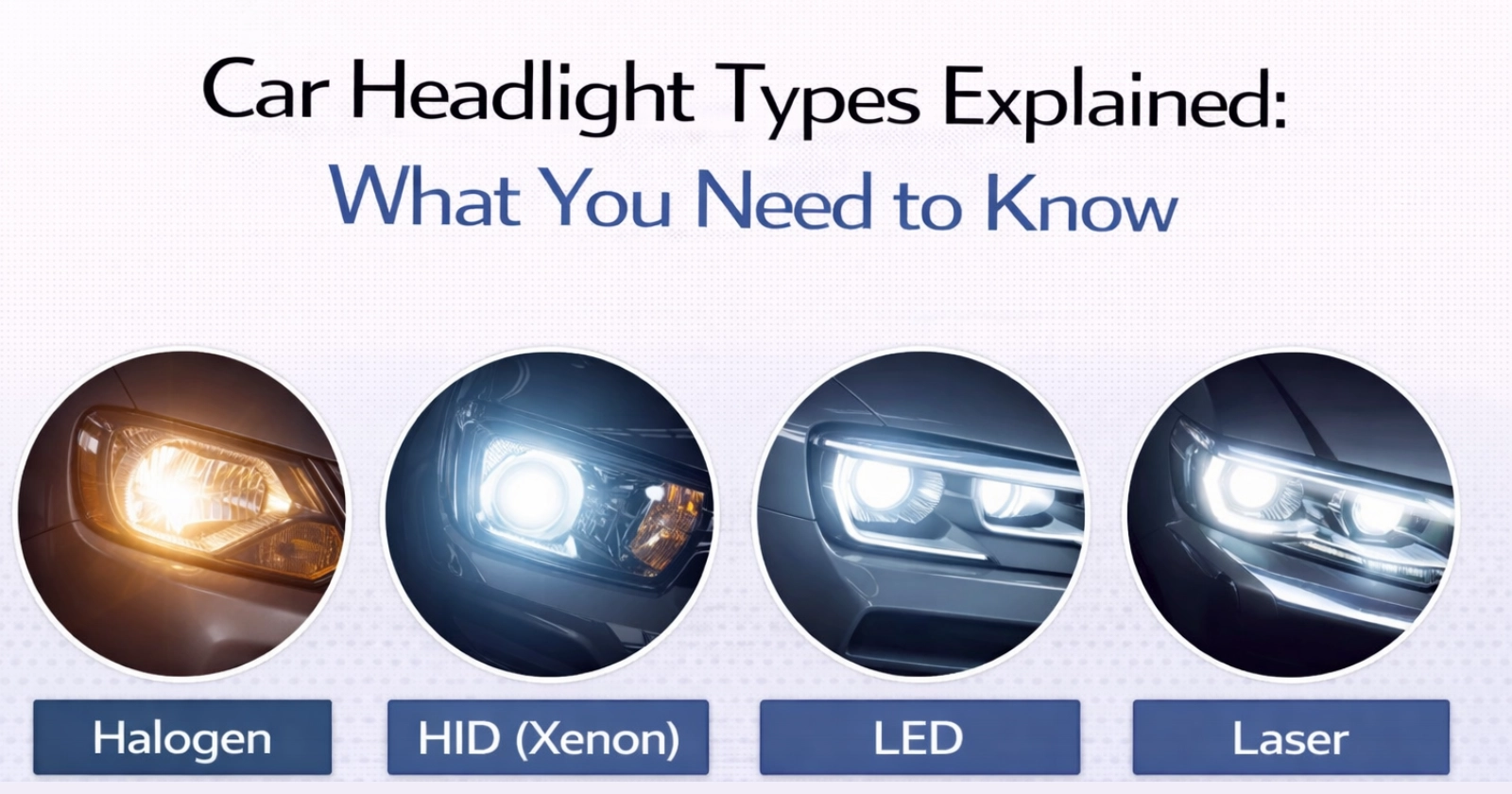
Halogen headlights
Halogen Headlight bulbs are broadly the most inexpensive and widely available option for automotive lighting. Halogen headlight bulbs use a tungsten filament located inside the bulb, which produces their yellowish colored light. These bulbs work by heating the filament until it begins glowing.
HID headlights
High-Intensity Discharge (HID) / (Xenon Headlights) Also commonly referred to as Xenon Headlights, High-Intensity Discharge Headlights can produce an extremely bright, White or Bluish light, by using an electric arc produced between electrodes instead of using a filament to produce the light.
LED headlights
LED Headlights (Light Emitting Diode) Headlights are created using semiconductor chips that produce a visible-light output. LED headlight systems provide maximum energy efficiency, have the longest lifetime, and instantaneously generate all of their brightness without any warm-up time.
Laser headlights
Laser headlights are the most advanced type of headlight currently available. They utilise laser diodes as a light source, producing extremely high-intensity light, which is converted to a very bright white beam with phosphor. Laser headlights provide exceptional brightness, greater distance up to twice the distance of LED headlights, and lower energy consumption.
Matrix and adaptive headlights
Matrix and Adaptive Headlights are part of a new breed of headlight systems that adapt the headlight beam throughout various driving environments, incorporating changing conditions such as traffic from oncoming cars and curves in the road.
Car Headlight Housing Designs
Headlight housing designs include the reflector and projector types, which affect the way light is projected.
Reflector headlights
Reflector-type headlights direct light through the headlight housing to the front of the car using a mirror (reflector) to direct the beam. Because reflector-style headlights are less complicated to manufacture than projector-type headlights, these products are used on older and less expensive vehicles because of their simplicity to produce.
Projector headlights
Using the lens aspect of Projector headlights puts your light very focused into a sharper beam pattern. Therefore, you are able to control more accurately how far your light beams go, thus providing you with less glare, but a more visible distance and clear sight while driving at night.
Light Characteristics
Having an understanding of the light characteristics will help you find the best headlight that fits your needs.
Colour temperature (kelvin ratings)
The Kelvin Ratings for Headlights refer to the different colour temperatures of the light produced by the Headlight. Lights that produce a lower Kelvin light (around 3000K) appear to be more of a yellow light, while higher Kelvin ratings (5700K - 6500K) would produce a bright white or bluish-white light.
Brightness and beam pattern
The Brightness of a headlight is rated in Lumens and determines how far and/or well the headlight illuminates the roadway. The Beam Pattern provides a description of how the light is shaped and how wide it is spread. The Beam Pattern helps determine whether the light shines directly on the road or produces a glare effect.
Comparing Car Headlight Types
The efficiency and cost-effectiveness of each headlight technology can differ significantly.
Typically, laser or LED headlight technologies provide the greatest visibility and beam focus, followed by HID headlights and halogen headlights. However, the performance of advanced adaptive systems can be improved through the dynamic adjustment of light outputs.
Energy efficiency
Both laser and LED headlights draw on much lower energy consumption rates than the halogen and HID headlight technologies. This helps improve overall fuel economy and create a lighter electrical load for vehicle power-train components.
Cost, lifespan, and maintenance
Halogen headlight technologies represent the least expensive headlight technology at the time of purchase, but the least amount of life. Although the more costly HID headlight technologies will last much longer than halogen technologies, LED and laser technologies have the longest life expectancy.
Safety and legal considerations
All drivers must maintain proper headlight alignment and ensure compliance with legal requirements regarding brightness and colour temperature to ensure safe use of headlights by all those using the road and to avoid receiving a citation for headlamp violations.
Best Car Headlight Types for Different Driving Situations
When selecting headlights, consider your normal driving habits to help determine which will work best for you.
City and suburban driving
In cities and suburbs, Halogen and LEDs provide enough light output to adequately illuminate your path while maintaining affordability and a reasonable beam pattern.
Rural and highway night driving
Rural areas can be quite remote at night with limited lighting, so you would want LEDs or HID headlights with increased brightness and long range, which will allow you to see potential hazards and road signs well in advance.
Off-road and heavy-duty use
Some of the most demanding environments to drive on would be off-road areas or the hauls of heavy loads; therefore, using heavy-duty LEDs or lasers is recommended, along with help from auxiliary lights.
Within the luxury and high-performance segment, Laser/LED and adaptive Matrix headlamps help improve your vehicle's style, safety and performance as they accommodate enhanced driving experiences.
To keep your headlights working as they should, it's important to do routine maintenance on them.
Upgrading to better technology
When you want to upgrade your headlights with a different technology, consider replacing your standard halogen bulb with either LED or HID, depending on what will work best in your vehicle.
Lens restoration and cleaning
Restoring and cleaning your headlight lens will improve the amount of light it produces and also help keep you safe and visible to others on the road.
Proper aiming and alignment
In order to ensure that you're getting the best amount of light, make sure your headlights are properly aimed and aligned before you drive.
Headlights for Different Vehicle Types
Different types of vehicles require different types of headlight options.
Gasoline and Diesel Vehicles
If you drive a gasoline or diesel vehicle, you'll likely find that it uses either a traditional halogen bulb, an HID bulb, or newer LED headlight designs.
Electric and hybrid vehicles
You'll also find that electric and hybrid vehicles will generally utilise LED or laser-based headlight designs due to energy efficiency and style.
Bottom Line
To sum it up, by knowing what type of headlights there are, what technology they utilise, and where you drive, you can make the best decision for safe driving and comfort. Although halogen is still considered cost-effective, LEDs and lasers will provide better performance over time as well as better design options.
By having regular maintenance performed on your headlights, professionally installed, and kept clean, your headlights will be able to offer maximum light output so that every road trip or other driving experience will be safe!
Frequently Asked Questions