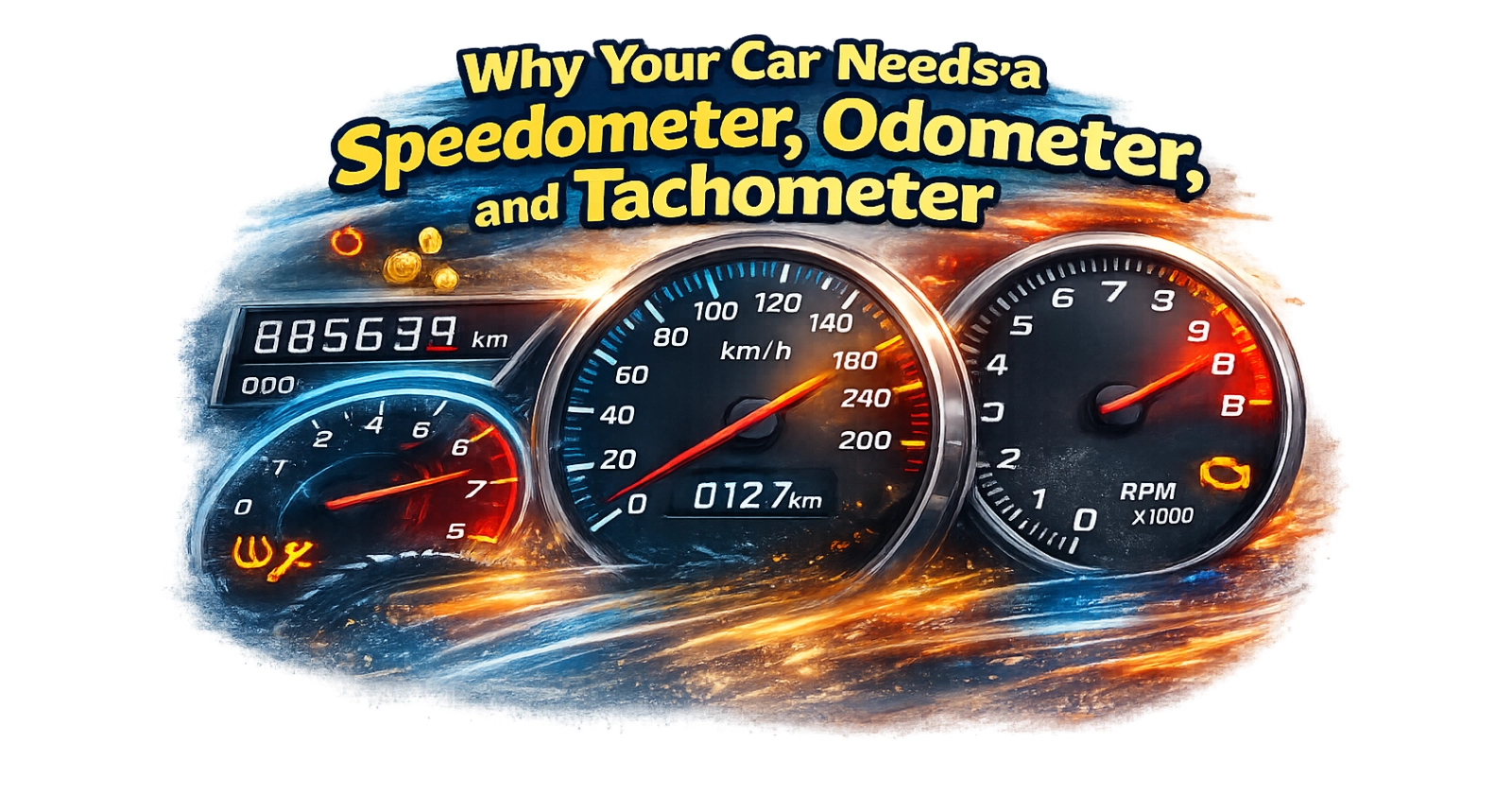
Why your car needs a speedometer
A speedometer is essential for safety and legal driving. Besides showing the rate at which a vehicle is going, it also shares its information with several other systems and driving behaviours.
- Helps you maintain safe driving speeds
Road conditions are constantly changing, and maintaining a safe speed is one of the most effective ways to avoid accidents. A good speedometer provides instant feedback, allowing you to adjust your pace accordingly when visibility is poor, the road is slippery, or traffic suddenly slows.
- Speeding tickets and legal violations avoided
Just a slight miscalculation of one's speed can lead to a fine. Since most roads use speed cameras and automated enforcement systems today, knowing your exact speed is the only way to avoid unintentional violations.
- It improves reaction control in traffic conditions.
Proper speed control means smooth driving. In heavy traffic, if you can keep track of your exact speed, tailgating, sudden braking, and sudden acceleration will be considerably less likely.
- Ensures safe driving in school zones and variable speed areas.
Most school zones, roadworks, and residential streets have speed limits in place for safety reasons. A good working speedometer means you will be in the best position to slow down appropriately the moment conditions change.
- Works with driver-assist systems that depend on accurate speed data.
Every modern vehicle relies on speed for a range of onboard systems, including cruise control, ABS, traction control, and stability control. Incorrect information from speedometer inputs can cause these systems to malfunction or to disable themselves altogether, hence compromising safety in its entirety.
Why your car needs an odometer
The odometer shows the total mileage (distance driven) the car has covered in its lifetime. The information affects regular maintenance, resale value, and system diagnostics.
- Tracks total distance for scheduled maintenance
Most servicing is based on mileage, including oil changes, timing belt replacements, filter changes, brake inspections, and many other jobs, which depend on accurate odometer readings. Neglecting such mileage-based maintenance inevitably results in very costly breakdowns.
- Helps determine the vehicle's resale value.
One of the primary factors that buyers consider when purchasing a car is its mileage. The lower the mileage, the less wear and tear is usually experienced by the engine, suspension, and transmission; thus, an accurate odometer reading is essential for a reliable sale.
- Ensures that the warranty and service history are correct.
Generally, manufacturers require proof of mileage for warranty claims. They might deny such claims in cases of faulty or incorrect odometers and also question the service history.
- Useful for road trips, fuel planning, and trip tracking.
The distance travelled helps the driver manage fuel, plan for longer journeys, and make necessary estimations of arrival time. Many drivers also rely on the trip odometer for shorter trips or for monitoring their fuel usage.
- Allows detection of possible problems with faulty sensors or extensive wear.
This would also include instances where the odometer suddenly stops, advances too quickly, or exhibits erratic movement, which may indicate a failing speed sensor, damaged gears, or electrical issues that require attention.
Why your car needs a tachometer
The tachometer measures the rotational speed of the engine in revolutions per minute (RPM), a measure of load on an internal combustion engine and its general performance.
- The display of the engine RPM avoids over-revving.
Over-revving can cause mechanical damage, especially in older engines or cars with manual transmissions. Monitoring RPM ensures the engine remains within the range it's designed to operate within for normal operation.
- Smooths the operation of gear shifting and promotes quick, easy changes.
Manual drivers depend on the tachometer to change gears at the appropriate time, so that the engine will not struggle or labour. Additionally, cars with automatic transmissions sometimes exhibit abnormal tachometer readings, which can be an indicator of shifting issues.
- Conveying load on the engine and performance health.
If the vehicle is often red-lining, moving at high speeds on low RPMs, it can lead to sudden accelerations, erratic punches, and jumpy movement, which can be harmful to the engine in the long run.
- It helps detect problems with either the engine or transmission.
If the needle acts erratically, for example, bounces or sticks, it could indicate problems with the engine control unit, crankshaft sensor, or parts of the transmission system.
- It helps improve fuel efficiency by avoiding high RPMs while driving.
Driving at unnecessarily high RPMs results in a significant amount of fuel being wasted. The tachometer helps maintain a balanced driving style, which reduces fuel consumption and prolongs engine life.
Common symptoms of faulty dashboard instruments
One cannot imagine dashboard gauges failing without warning; thus, the ability to recognise them at an early stage will help avoid incorrect readings and accidents that may prove harmful.
The speedometer is displaying an incorrect reading.
In this way, when the speedometer suddenly jumps, then moves slowly, or freezes, the vehicle speed sensor, wiring, or internal cluster components are failing.
Odometer stuck, jumping, or not counting distance
This could be due to faulty gears inside the cluster, a broken sensor, or poor electrical connections.
Tachometer needle bouncing, lagging or reading abnormally
Abnormal tachometer behaviour is usually an indication of one of the following: an ignition problem, an ECU issue, a malfunctioning crankshaft sensor, or a failing cluster motor.
Illuminated warning lights: Check Engine and ABS lights.
Faults in the cluster electronics can send false signals to the car's computer, turning on warning lights even when no mechanical issue is present.
Dim or flickering instrument cluster
It typically indicates a problem with the alternator, a weak battery, corroded connectors, or failing backlight bulbs.
Sudden changes in fuel economy or shifting behaviour
Incorrect speed or RPM information can cause the engine control unit to deliver the wrong fuel or set incorrect shift points, thereby affecting the vehicle's overall performance.
How to fix or prevent instrument cluster problems
Generally speaking, problems with the instrument cluster are electrical in nature. Regular check-ups and simple maintenance can prevent most failures.
Check and replace damaged fuses or wiring
Poor wiring and blown fuses are among the most common causes of instrument malfunctions. A quick restoration of function may be achieved by inspecting and replacing these components.
Check the VSS or Crankshaft Sensor
These sensors send speed and RPM details to the dashboard. Their surface might corrode or become covered with dirt, or it might be damaged, sending the wrong signals. Their cleaning or replacement may provide the answer.
Repair or replace the faulty stepper motors in the cluster.
Stepper motors drive the needles. If these motors fail, the needles can stick, lag, or, worse, move in very unpredictable ways. A technician can often resolve such a problem easily by replacing it.
Keep the battery and alternator in optimal condition
The instrument cluster needs a stable voltage. A weak alternator or ageing battery will cause flickering lights, erroneous readings, or complete cluster failure.
Prevent moisture buildup inside the dashboard
Additionally, humidity can corrode the circuits and connectors. Parking in dry areas reduces corrosion; repairing leaks and ensuring proper cabin ventilation further protects the electronics.
Schedule periodic diagnostics with a professional mechanic.
A yearly diagnostic check helps to identify failing sensors, wiring defects, and early electrical problems before they become serious.
Bottom Line
Each one of them-the speedometer, the odometer, and the tachometer plays an important role in the safety, efficiency, and long-term reliability of your car. They provide very important information that influences everything from daily driving habits to routine maintenance and early fault finding. A well-maintained instrument cluster ensures accurate readings and consistent performance, generally leading to safer driving.
Frequently Asked Questions