
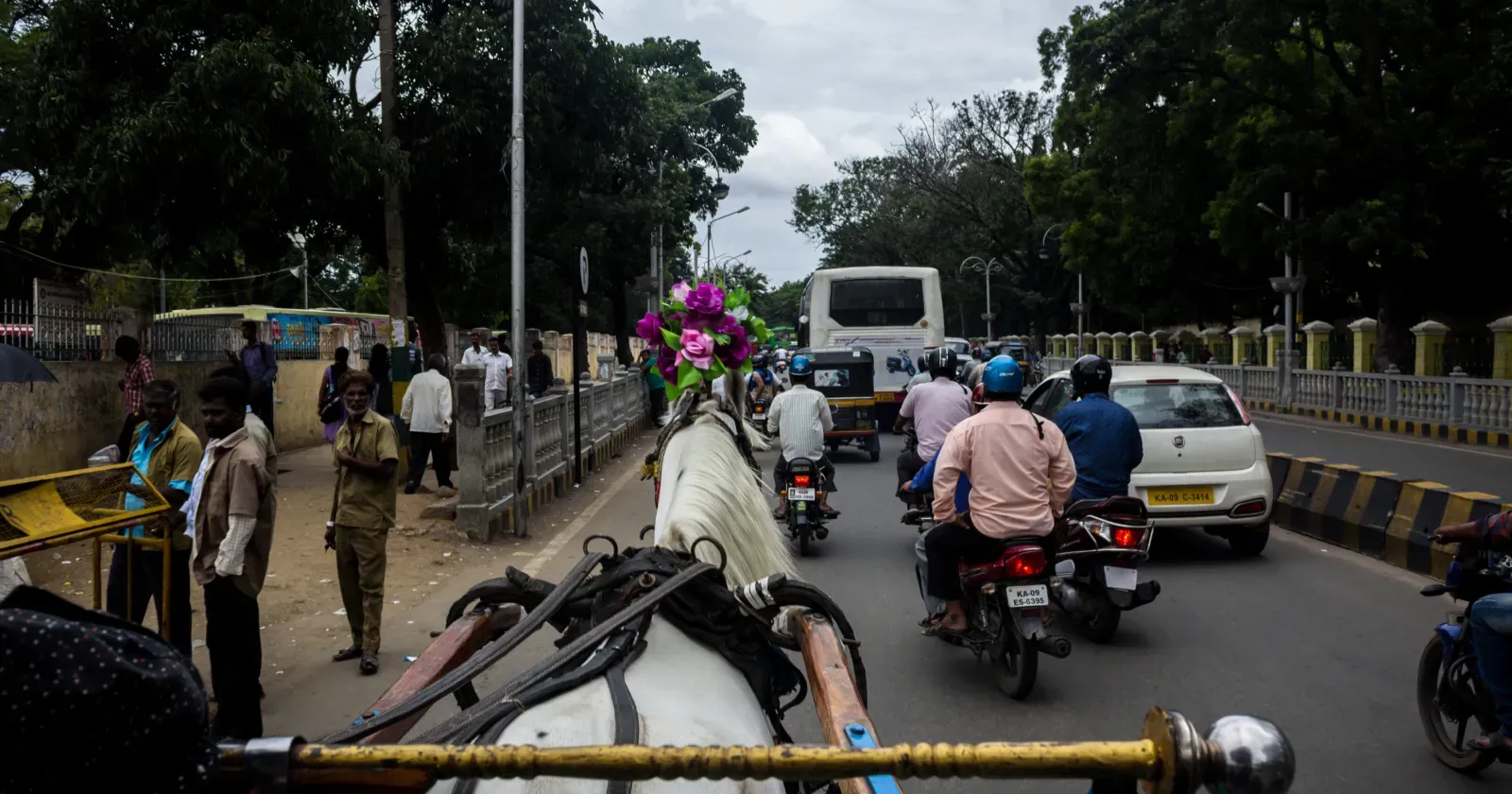
Indian roads pose unique challenges for ADAS, with stray animals, erratic drivers, and unpredictable pedestrians complicating pattern recognition and system reliability.



Share Post
Indian roads pose unique challenges for ADAS, with stray animals, erratic drivers, and unpredictable pedestrians complicating pattern recognition and system reliability.
With safety being one of the biggest priorities for a modern car buyer, Advanced Driver Assistance System or ADAS has been one of the most discussed automotive technologies in recent years. ADAS uses sensors, cameras, and radar to enhance vehicle safety by assisting drivers with tasks such as collision avoidance, lane keeping, adaptive cruise control, and automated braking.
It improves situational awareness, reduces human error, and serves as a foundation for higher levels of vehicle automation. In short, it is a real world application of artificial intelligence for vehicular safety and convenience. That said, any technology comes with its own set of challenges. In this case, undefined variables in different circumstances are the biggest constraints.
Most ADAS technologies in use today have been developed for the roads of developed countries, where traffic violation is a serious offence. Unfortunately, that cannot be said for Indian roads, drivers, and even pedestrians. Moreover, the variables in Indian driving conditions are far more unpredictable than what you would usually expect on average European or American roads.
Acko Drive recently got to interact with Ramanathan Srinivasan, Managing Director, Automotive Test Systems, on the sidelines of the SIAM Summit for Automotive Future Advancement in Road Safety (SAFAR) and gain some critical insights about ADAS being developed for Indian conditions.

One of the most significant challenges for ADAS development in India lies in road infrastructure. While ADAS technologies in Western markets often rely on well-marked lanes and standardized road layouts, Indian roads can be far less predictable. “You have lane markings somewhere, in many cases you have traffic coming from both directions. And it is a little bit complex in terms of people moving in from different directions in different crossings and intersections,” Ramanathan explained.
Inconsistent lane markings, poorly defined intersections, and multi-directional traffic flows complicate systems such as lane-keeping assist and adaptive cruise control. Unlike controlled highway environments, Indian roads demand that ADAS systems operate effectively even when visual cues are unclear or missing.
Further, road signage may be limited or absent in certain regions, placing greater emphasis on sensor robustness and intelligent perception systems. Technologies must be capable of functioning reliably even when the physical infrastructure does not fully support structured driving patterns.
Beyond infrastructure, India’s extraordinary traffic diversity sets it apart. ADAS systems must account for a far broader range of road users than in many other markets. For instance, cattle and stray animals roaming on roads, cyclists and pedestrians sharing carriageways with motor vehicles, and widespread disregard for traffic norms are common occurrences in India. So how does one factor in these variables while developing ADAS specifically for Indian roads?
“In terms of the density and the variety of traffic, we are very different,” Ramanathan emphasized. “From a cow to a dog to the e-rickshaws to cycle rickshaws to cyclists… even tractors and earth-moving equipment.”
This mix exists not only in rural areas but also on highways and urban roads. Vehicles of vastly different speeds and sizes share the same space, often without clear segregation. Pedestrians may cross roads “anywhere at any point in time,” even in the absence of zebra crossings. Such unpredictability demands highly advanced object detection and classification capabilities. ADAS systems must distinguish between animals, two-wheelers, heavy machinery, and pedestrians, while also anticipating sudden movements.
Environmental factors add another layer of difficulty. Indian driving conditions frequently include fog, heavy rainfall, mud-covered roads, and extreme temperatures. Bright sunlight and reflections from bridges can interfere with sensor performance. “We have fog, we have rain, we have mud, we have everything on the street,” Ramanathan remarked.
Radar sensors, in particular, can be sensitive to reflections and environmental interference. ADAS systems deployed in India must therefore be rigorously validated across varied weather and lighting conditions. Ensuring sensor accuracy and reliability in such diverse environments is critical for safety and consumer trust.
A defining theme in the development of ADAS for India is the need to incorporate human behaviour into system design. “ADAS will be there but human behaviour cannot be discounted,” Ramanathan stated. Importantly, behavioural considerations apply to both drivers inside the vehicle and road users outside it.
Indian drivers often operate with urgency. “By nature itself, we want to do everything quickly and we are sort of in a hurry to reach our next location,” he explained. This can sometimes manifest as aggressive driving or rule violations. At the same time, Indian drivers tend to maintain heightened situational awareness. “Here you know that anytime, anything can happen in front of you… your mind is continuously active.”
This constant alertness functions as a survival mechanism in unpredictable traffic environments. However, distractions such as mobile phone use can quickly increase risk. For ADAS developers, this duality presents a challenge: systems must support drivers without encouraging overreliance or complacency.
Beyond assisting the driver, ADAS in India increasingly focuses on predicting the behaviour of others on the road. With advancements in AI, systems can begin to interpret subtle cues. The expert provided practical examples: “In Chennai, sometimes the auto driver gives a small indication with his leg that he is going to turn right or left.” Similarly, “Sometimes a two-wheeler guy just turns a little bit, which means he is going to turn right.”
These micro-behaviours can act as predictive signals. Research institutions and universities in India are studying such patterns to answer critical questions: Will a pedestrian cross the road? Will they stop midway? Will they retreat?
“According to that, your ADAS has to behave,” he noted. This shift from reactive detection to predictive modelling marks an important evolution in ADAS capability within the Indian context.
Currently, ADAS features are primarily available in premium vehicles, raising questions about accessibility. However, the broader societal cost of road accidents reframes the economic debate. “What is the cost of a life?” the expert asked, referencing the hundreds of thousands of families affected annually by road fatalities and injuries. The economic impact is significant, with nearly ₹6 lakh crore of GDP affected.
He suggested that legislation mandating ADAS could drive economies of scale. “India is a growing market… we are selling vehicles in millions. So, the cost is going to get divided across.” Higher volumes would naturally reduce per-unit costs, facilitating adoption in the mass segment.
Insurance incentives may also accelerate adoption. “Insurance companies obviously can charge lesser premiums on cars with ADAS,” reflecting global trends where safer vehicles benefit from reduced insurance costs. Additionally, government incentives — similar to those offered for electric vehicles — could help offset initial costs while generating long-term public savings through reduced medical and compensation expenditures.
Also READ: New Delhi Road Safety Declaration Launched, To Accelerate Action Towards Road Fatalities
The introduction of ADAS testing in the upcoming Bharat NCAP 2.0 regulations will mark a significant milestone for vehicle safety in India. According to Ramanathan, this is “the start point.” Initial regulations may focus on defined use cases, such as pedestrian and cyclist detection. However, he anticipates broader integration in the future, potentially combining physical and virtual testing methods during homologation.
“Thousands of use cases can be brought in and tested and validated” through virtual simulations before vehicles are approved for market entry. Such an approach would strengthen validation processes and ensure ADAS systems are prepared for India’s complex road scenarios.
Finally, the behavioural research and AI development supporting ADAS may serve as a foundation for autonomous driving technologies in India. Companies are already working on AI-based algorithms tailored to local conditions. Autonomous systems rely on two essential components: perception and path planning. “The first is to look at it… what is going to happen. And then accordingly do a path planning,” the expert explained.
In a country where unpredictability is the norm, mastering perception and predictive modelling is particularly critical. While fully autonomous vehicles may still be some distance away, current ADAS advancements are laying essential groundwork.

From Cows to Chaos: Why ADAS Systems Must Be Reengineered for India
Arun Prakash 21 Feb, 2026, 7:33 AM IST
Ola Announces Gen 3 Scooter, Bike Upgrade Programme for Current Owners
Acko Drive Team 21 Feb, 2026, 7:02 AM IST
2026 Tata Punch EV Facelift Variants and Features Explained
Acko Drive Team 20 Feb, 2026, 3:24 PM IST
Refreshed Tata Punch EV Aims to Massify EVs in Entry-Level Car Segment, Leveraging Falling Battery Prices, Product Optimisation
Sumantra Bibhuti Barooah 20 Feb, 2026, 12:29 PM IST
Beyond Commute: 8 Cultural Events Redefining Indian Motorcycling
Acko Drive Team 20 Feb, 2026, 11:58 AM IST

Looking for a new car?
We promise the best car deals and earliest delivery!
