

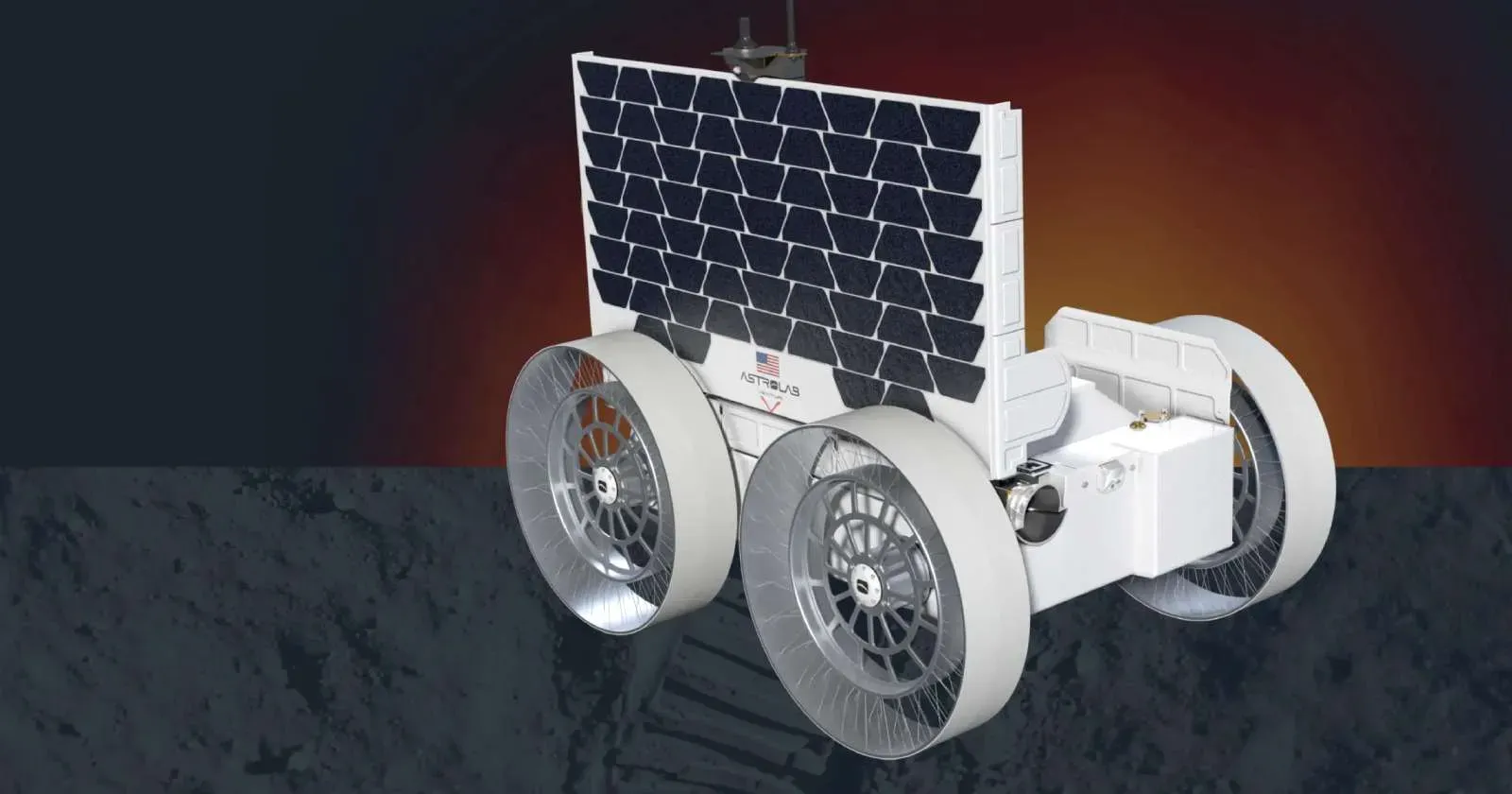
Space exploration startup Astrolab is set to launch an autonomous lunar rover named FLIP to the moon later this year as part of preparations for future NASA missions including the Artemis programme which aims to send humans to the moon for the first time in over 50 years. Among the rover’s payloads is a Hewlett Packard Enterprise Spaceborne Computer-4 module, developed and engineered specifically to operate in such a challenging environment.
The high-performance computer is capable of running local large-language models (LLMs), the foundation for today’s AI models. The experiment aims to help researchers understand how future human habitation on the moon might take shape. This will be the first time that AI computations are performed on the surface of the moon itself.
HPE plans to demonstrate and test the resilience of its Spaceborne Computer, as well as its ability to run core AI applications on the moon, paving the way for autonomous environmental monitoring and analysis to help future long-term inhabitants. Processing data locally will mean mission control, mapping, navigation, construction, and even cybersecurity data can be analysed and turned into usable information without the lag of transmitting and receiving over massive distances. The Spaceborne Computer-4 is designed to run without cooling fans. It has dedicated low-power CPU and GPU subsystems and is equipped with solid-state storage, all designed to withstand the rigours of the lunar environment.
The FLIP rover (Flex Lunar Innovation Platform) will be launched to the moon’s south pole aboard a SpaceX Falcon Heavy reusable rocket. The NASA mission, designated Griffin Mission One, is currently set for an unspecified launch date this November, two years after ISRO's successful Chandrayaan-3 mission sent the Vikram lander and Pragyan rover to the same region. FLIP is designed to survive lunar dust, with hyper-deformable wheels designed by partner firm Venturi. It is equipped with a moveable solar panel, and its batteries can store enough energy to survive lunar nights.
FLIP will also be equipped with research equipment from various NASA programmes including multicolour camera and radiometer to detect Helium-3 in the lunar regolith; a laser retroreflector array for precision tracking using an orbital laser altimeter; a lunar dust level sensor to study the degradation of critical hardware functions including cooling and solar power generation; and a lunar LiDAR module to generate high-resolution 3D surface maps.
In addition to its scientific uses, FLIP is designed to be a technology demonstration and precursor for a much larger planned fleet of rovers called FLEX. This future model is planned to carry up to two humans and up to 1600 kg of cargo. It will be able to be operated remotely, to support deeper exploration and research. It can also handle logistics operations, including construction and regular economic activity on the moon or even Mars. The FLIP mission will test tyres, batteries, sensors, and avionics systems that can be used for future FLEX development.