Toyota Kirloskar Motor (TKM) has signed a Memorandum of Understanding with the National Institute of Solar Energy (NISE), under the Ministry of New and Renewable Energy, to support India’s National Green Hydrogen Mission.
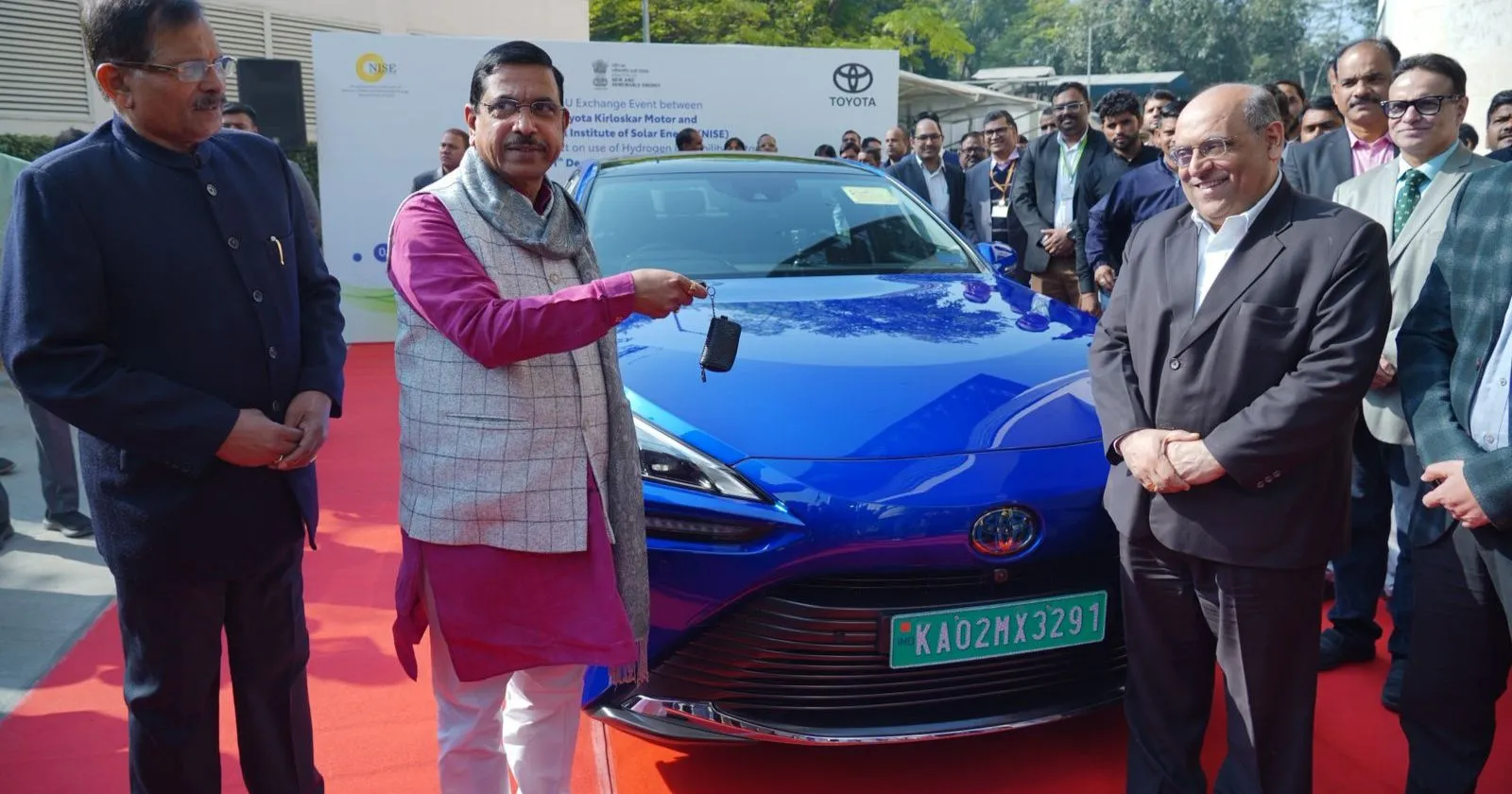
As part of the agreement, TKM handed over a second-generation Toyota Mirai hydrogen fuel-cell electric vehicle to NISE for detailed real-world testing across Indian conditions.
The study will evaluate the Mirai’s performance in areas such as fuel efficiency, range, refuelling behaviour, drivability in varied terrain, operation in cold and hot climates, and resilience to dust and traffic. The findings will help assess hydrogen mobility’s suitability for India’s diverse road and weather conditions.
The MoU exchange took place in the presence of Union Minister Shri Pralhad Joshi (New and Renewable Energy), Minister of State Shri Shripad Yesso Naik, Secretary Shri Santosh Kumar Sarangi, Mission Director Shri Abhay Bakre, NISE Director General Dr Mohammad Rihan, and senior TKM executives including Mr Vikram Gulati and Mr Sudeep Dalvi.
Pralhad Joshi said the partnership marks a practical step toward implementing India’s clean-energy goals and building domestic hydrogen capability. TKM’s Vikram Gulati reiterated the company’s multi-pathway approach (combining hydrogen FCEVs, BEVs, hybrids and alternative fuels) to support India’s net-zero and energy-independence targets.
The Toyota Mirai generates electricity onboard through a hydrogen-oxygen reaction, emitting only water vapour. It offers a range of around 650 km and refuels in under five minutes.
TKM operates two plants in Bidadi, Karnataka, with a combined capacity of 3.42 lakh units annually and employs over 6,500 people. The company remains committed to carbon neutrality by 2050 across its lifecycle through renewable energy, circularity and ecosystem conservation.