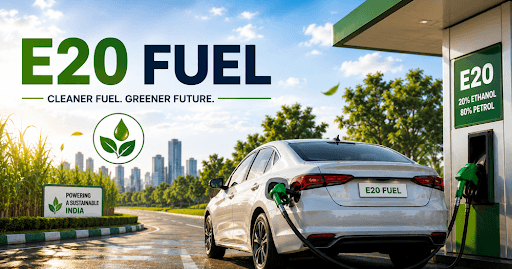
What Is E20 Fuel?
E20 fuel is a blend consisting of 20% ethanol and 80% petrol. Ethanol is a renewable fuel produced from agricultural feedstocks such as sugarcane, maize and other biomass sources. The aim of increasing the ethanol content in petrol is simple: to reduce dependence on crude oil imports. In other words, the focus is on promoting cleaner mobility.
Compared to conventional petrol, E20 fuel contains a higher proportion of ethanol. While the fuel itself looks and behaves similarly to regular petrol, vehicles need to be compatible with the blend to ensure optimum performance and durability.
E20 Fuel vs Conventional Petrol
Although E20 fuel can be used much like regular petrol, there are some important differences in composition, emissions and vehicle compatibility. Here's how E20 fuel compares with conventional petrol:
Parameter | E20 Fuel | Regular Petrol |
Ethanol content | 20% | Typically up to 10% or lower |
Petrol content | 80% | Nearly 100% |
Source | Petrol + renewable ethanol | Fossil fuel-based petrol |
Emissions | Lower greenhouse gas emissions | Higher emissions |
Energy density | Slightly lower | Higher |
Fuel efficiency | Slightly lower | Higher |
Vehicle compatibility | E20-compatible vehicles recommended | Compatible with all petrol vehicles |
India imports a significant portion of its crude oil requirements, making fuel prices vulnerable to fluctuations in global markets. Increasing ethanol blending helps reduce dependence on imported fossil fuels while strengthening the country's energy security.
The transition to E20 fuel is also expected to support domestic ethanol production and create opportunities for farmers and industries associated with the biofuel ecosystem.
Some of the key objectives behind the E20 rollout include:
- Reducing crude oil imports
- Lowering emissions from conventional vehicles
- Promoting the use of renewable fuels
- Supporting domestic ethanol production
- Strengthening energy security
Benefits of E20 Fuel
E20 fuel offers several advantages for both consumers and the broader automotive ecosystem. From reducing dependence on crude oil imports to supporting cleaner mobility, here's a look at some of its key benefits:
Reduced Dependence on Imported Oil
Since ethanol can be produced domestically, increasing its share in petrol helps reduce India's reliance on imported crude oil and limits exposure to fluctuations in international fuel prices.
Cleaner Alternative to Conventional Petrol
Ethanol is derived from renewable sources and is considered cleaner than conventional petrol. Increased ethanol blending can help reduce greenhouse gas emissions and contribute to cleaner mobility.
Supports the Rural Economy
The growth of ethanol production creates additional demand for feedstocks such as sugarcane and maize. This benefits farmers and encourages investment in industries associated with storage, logistics and processing.
Easier Adoption
Unlike electric vehicles, E20 fuel does not require new infrastructure or changes in ownership habits. Drivers can continue using fuel stations as usual, making the transition relatively seamless.
Drawbacks of E20 Fuel
While E20 fuel offers several environmental and economic benefits, it also comes with a few limitations, such as:
Reduced Fuel Efficiency
Since ethanol contains less energy than petrol, vehicles running on E20 fuel may experience a slight reduction in fuel efficiency. However, the impact is generally minimal on vehicles designed to support E20 fuel.
Limited Compatibility With Older Vehicles
While many modern petrol vehicles are designed to support E20 fuel, compatibility may vary for older models developed for lower ethanol blends. For example, manufacturers such as Honda, Volkswagen and Škoda have confirmed E20 compatibility for several older models, while compatibility may differ for others.
Engine and Fuel System Wear
Ethanol has different chemical properties from petrol and may affect certain engine and fuel system components in vehicles over time. This is because ethanol can affect materials such as rubber, plastic and certain metals used in older fuel systems. Always use the fuel recommended by the manufacturer to avoid such issues.
Dependence on Ethanol Production
The success of E20 fuel depends on a reliable supply of ethanol produced from agricultural feedstocks such as sugarcane and maize. Meeting the growing demand for ethanol while ensuring sustainable production and efficient resource utilisation remains an important consideration.
E20 Fuel Compatibility & Mileage: What Vehicle Owners Need to Know
Most petrol vehicles manufactured from 1 April 2023 onwards are designed to safely support E20 fuel. Vehicles manufactured from April 2025 onwards are fully E20-compliant, with engines and components optimised to deliver the best performance on E20 fuel.
Since ethanol contains less energy than petrol, vehicles running on E20 fuel may experience a slight reduction in fuel efficiency. However, the impact is generally expected to be minimal for E20-compatible vehicles, and everyday drivability remains largely unaffected.
The List of E20-Compatible Cars in India
The following table lists E20-compatible cars sold in India.
Car Manufacturer | E20-Compliant Models |
Maruti Suzuki | Alto K10, S-Presso, Eeco, Celerio, Wagon R, Swift, Ignis, Baleno, Dzire, Fronx, Brezza, Ertiga, XL6, Jimny, Grand Vitara, Invicto, Victoris |
Tata Motors | Punch, Tiago, Tigor, Altroz, Nexon, Harrier, Safari, Sierra |
Hyundai | Exter, Grand i10 Nios, Aura, i20, i20 N Line, Venue, Venue N Line, Creta, Creta N Line, Alcazar, Verna |
Mahindra | XUV 3XO (2023 onwards), Thar, Thar Roxx, XUV 7XO, Scorpio N |
Toyota | Glanza, Urban Cruiser Taisor, Urban Cruiser Hyryder, Innova Hycross, Fortuner, Camry, Vellfire |
Kia | Syros, Sonet, Seltos, Carens, Carens Clavis, |
MG Motor | Astor, Hector, Hector Plus |
Volkswagen | Virtus, Taigun, Tiguan R Line, Golf GTI, Tayron |
Skoda | Kylaq, Kushaq, Slavia, Octavia VRS, Kodiaq, Kodiaq RS |
Honda | Amaze, City, City Hybrid, Elevate |
Renault | Kwid, Triber, Kiger, Duster |
Citroen | C3, Basalt X, Aircross X |
Nissan | Gravite, Magnite, Tekton, X-Trail |
Lexus | LM 350h, NX 350h |
The Road Ahead for E20 Fuel in India
E20 petrol has already been rolled out across the country under the Ethanol Blended Petrol (EBP) Programme. Oil marketing companies have expanded the supply network to make E20 fuel widely available. As a result, motorists in most parts of India can now access E20 petrol at fuel stations.
The nationwide rollout marks an important milestone in India's efforts to reduce dependence on crude oil imports and promote cleaner mobility. While electric vehicles, hybrids and CNG vehicles are expected to coexist, ethanol-blended fuels are likely to play an important role in reducing dependence on fossil fuels.
Going forward, E20 fuel is expected to strengthen the country's biofuel ecosystem and support domestic ethanol production. It could also pave the way for higher ethanol blends and wider adoption of flex-fuel vehicles, making it an important part of India's evolving mobility landscape.
Frequently Asked Questions