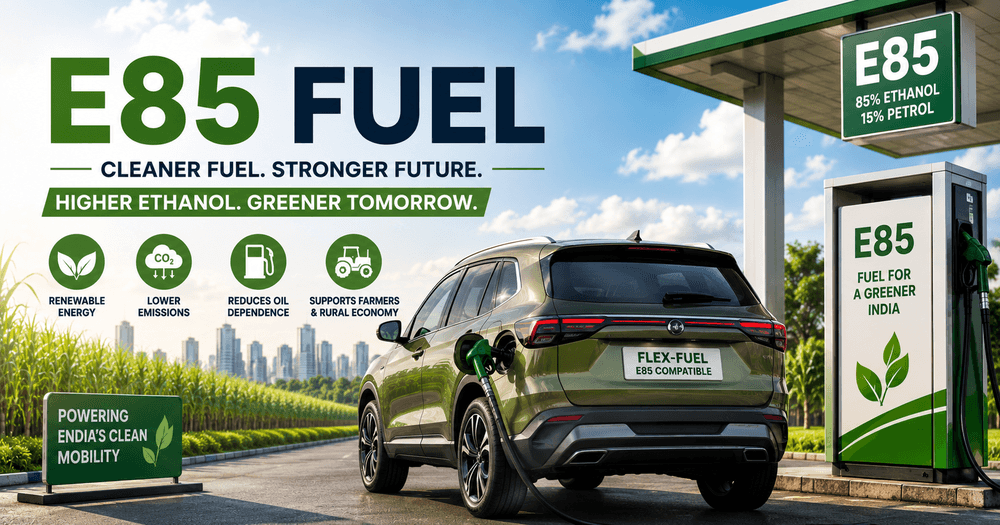
What Is E85 Fuel?
E85 fuel is a blend consisting of 85% ethanol and 15% petrol. Ethanol is a renewable fuel derived from agricultural feedstocks such as sugarcane and maize. Compared to E20 fuel, E85 contains a significantly higher proportion of ethanol and is intended for use in specially designed flex-fuel vehicles (FFVs).
Unlike regular petrol-powered vehicles, FFVs are equipped with components and engine management systems that can automatically adapt to different ethanol concentrations.
E85 Fuel vs E20 Fuel: What's The Difference?
Although both E20 and E85 are ethanol-blended fuels, they differ considerably in composition, vehicle compatibility and availability.
Parameter | E20 Fuel | E85 Fuel |
Ethanol content | 20% | 85% |
Petrol content | 80% | 15% |
Vehicle compatibility | Most modern petrol vehicles | Flex-fuel vehicles (FFVs) |
Fuel efficiency | Slight impact | Lower than petrol |
Availability in India | Widely available | Limited |
Fuel infrastructure | Existing network | Still developing |
Why Is E85 Fuel Gaining Attention?
Although E20 petrol has already become mainstream in India, higher ethanol blends such as E85 are attracting attention for their potential to strengthen the country's biofuel ecosystem. The recent introduction of E85 fuel by Indian Oil Corporation has further highlighted the country's intent to prepare for the wider adoption of flex-fuel vehicles.
Some of the factors driving interest in E85 fuel include:
- Reducing dependence on crude oil imports
- Increasing the use of renewable fuels
- Supporting domestic ethanol production
- Strengthening energy security
- Encouraging flex-fuel vehicle adoption
Benefits of E85 Fuel
E85 fuel offers several advantages and is expected to play an important role in the development of India's biofuel ecosystem.
Reduced Dependence on Fossil Fuels
Since ethanol can be produced domestically, higher ethanol blends can help reduce reliance on imported crude oil and improve energy security.
Lower Emissions
E85 fuel is considered a cleaner alternative to conventional petrol because of its higher renewable content and lower carbon footprint.
Supports Agriculture and Rural Economy
Greater demand for ethanol can spur investment in biofuel production and create opportunities for farmers and related industries.
The availability of E85 fuel can support the growth of flex-fuel vehicles and diversify India's clean mobility options.
Challenges Facing E85 Fuel Adoption
Despite its potential benefits, E85 fuel also faces several challenges that may affect its widespread adoption.
Lower Fuel Efficiency
Since ethanol contains less energy than petrol, vehicles running on E85 may consume more fuel and deliver lower mileage.
Limited Fuel Infrastructure
Unlike E20 petrol, E85 fuel is currently available only on a limited scale in India. Wider availability and supporting infrastructure will be crucial for its large-scale adoption.
Vehicle Compatibility
E85 fuel cannot be used in conventional petrol vehicles. It requires flex-fuel vehicles equipped with ethanol-compatible components and engine management systems.
Limited Consumer Awareness
Flex-fuel technology and higher ethanol blends are still relatively new concepts for many Indian buyers.
Which Vehicles Can Use E85 Fuel?
Regular petrol vehicles are not designed to run on E85 fuel. Since E85 contains a much higher concentration of ethanol, it requires flex-fuel vehicles equipped with specialised components and advanced engine management systems. It should not be used in conventional petrol or diesel vehicles.
Some of the notable flex-fuel vehicles in India include:
- Maruti Suzuki Wagon R Flex Fuel (Passenger car): Designed to support ethanol blends from E20 up to E100, including E85.
- Hero Splendor+ Flex Fuel (Motorcycle): Compatible with ethanol blends from E20 to E85.
- Hero HF Deluxe Flex Fuel (Motorcycle): Another FFV offering from Hero MotoCorp that is compatible with ethanol blends from E20 to E85.
- Suzuki Gixxer SF 250 Flex Fuel (Motorcycle): An E85-compatible flex-fuel motorcycle designed to operate on higher ethanol blends.
As more manufacturers introduce fuel-flex models, the range of E85-compatible vehicles is expected to expand.
Availability of E85 Fuel in India
E85 fuel is currently available only on a limited scale in India. Indian Oil Corporation has introduced E85 fuel at select retail outlets as part of the country’s broader push towards cleaner mobility and higher ethanol blends.
Some of these outlets are located in cities such as Mumbai and Delhi, where pilot projects and early adoption initiatives are underway. However, it is not yet as widely available as petrol or E20 fuel, and the supporting infrastructure is still developing.
How Much Does E85 Fuel Cost?
The price of E85 fuel may vary depending on factors such as location, fuel taxes and government policies. As of the latest rollouts:
- Delhi: ₹82.12 per litre
- Mumbai: ₹91.18 per litre
E85 fuel is priced lower than regular petrol prices in both cities, making it an attractive option for owners of compatible FFVs. However, overall running costs may differ because vehicles running on E85 typically have lower fuel efficiency than petrol vehicles.
What's Next for E85 Fuel in India?
Although E85 fuel is not widely available in India today, the country has already begun developing standards and regulations for its adoption. Several automakers have also showcased flex-fuel prototypes capable of operating on higher ethanol blends. For instance, the Maruti Suzuki Wagon R Flex Fuel became India's first mass-market passenger vehicle designed to run on E85 fuel.
As India's biofuel ecosystem evolves, E85 fuel could complement E20 petrol and support wider adoption of flex-fuel vehicles. However, fuel infrastructure, vehicle availability and consumer acceptance will play a crucial role in determining its long-term success.
Frequently Asked Questions (FAQs)