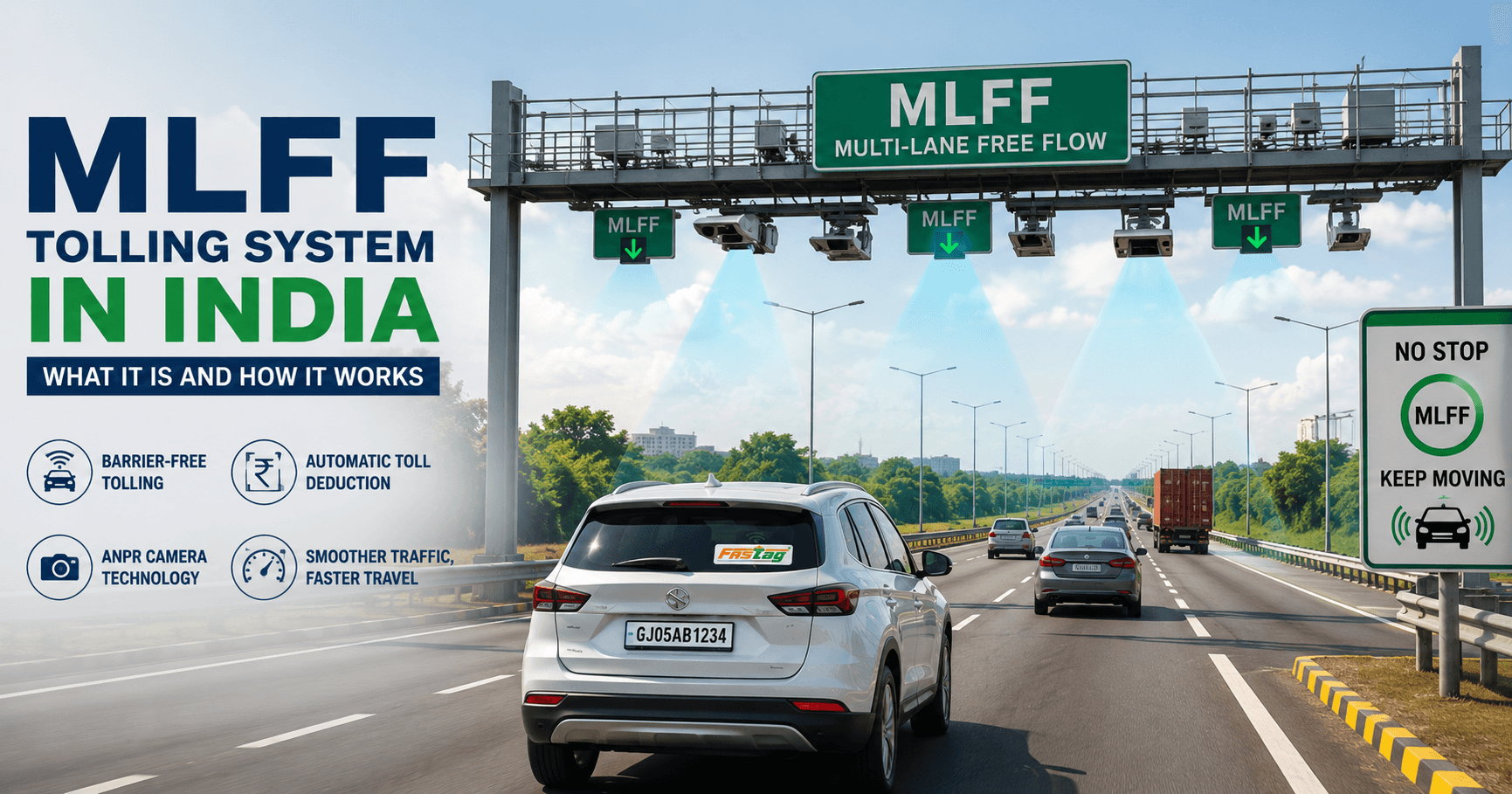
What is MLFF (Multi-Lane Free Flow) Tolling?
MLFF, or Multi-Lane Free Flow, is an electronic tolling system that allows vehicles to pass through toll points without stopping or slowing significantly.
Unlike conventional toll plazas with barriers and dedicated lanes, MLFF uses overhead gantries equipped with cameras and sensors to detect vehicles moving at regular highway speeds. The toll amount is then calculated and automatically deducted via digital payment systems linked to the vehicle.
In simple terms, MLFF aims to make toll collection faster, smoother, and completely barrier-free.
How Does the MLFF Tolling System Work?
The MLFF Tolling system combines multiple technologies to identify vehicles and process toll payments in real time. Instead of relying only on physical toll booths, the system uses cameras, RFID-based FASTag verification, and digital monitoring systems to enable automatic toll collection.
Let’s take a closer look:
Automatic Number Plate Recognition (ANPR)
High-speed ANPR cameras installed on overhead gantries capture the vehicle’s registration number as it passes through the tolling point. The system then matches the number plate details with a central vehicle database for identification and verification. This technology helps enable barrier-free toll collection without requiring vehicles to stop at dedicated lanes.
FASTag and RFID Integration
The MLFF setup in India currently works alongside the FASTag infrastructure. RFID scanners detect the FASTag sticker placed on the windshield and use it for payment authentication and toll deduction.
Using both ANPR and FASTag together improves vehicle identification accuracy and helps reduce payment-related errors.
Sensors and Vehicle Tracking
The system also uses axle detection sensors, LiDAR sensors, and weigh-in-motion (WIM) scanners installed at toll collection points to help identify the type and category of the vehicle. This is important because toll charges vary depending on the type of vehicle: car, SUV, bus, truck, or multi-axle commercial vehicle.
LiDAR (Light Detection and Ranging) technology uses laser-based scanning to detect vehicle dimensions and movement in real time, even at high speeds. Since these systems also track vehicle movement across toll-enabled highway sections, they help improve tolling accuracy, traffic monitoring, and overall highway efficiency.
Automatic Toll Deduction
Once the vehicle is identified and classified, the toll amount is deducted automatically from the linked FASTag wallet or payment account. Drivers do not need to stop, scan, or manually make payments during the process.
What Happens if There Is No Valid FASTag or Sufficient Balance?
The current MLFF system in India still relies on FASTag for toll payments and verifications. If a vehicle does not have a valid FASTag or has insufficient balance, the system uses ANPR cameras to capture the vehicle’s registration number and generate an electronic notice, i.e. an e-Notice.
Upon receiving this notice, vehicle owners must pay the outstanding toll amount within 72 hours. Failure to make the payment within the given time period may result in the authorities charging up to twice the applicable toll amount as a penalty. Continued non-payment may lead to FASTag blacklisting and other restrictions linked to the vehicle registration details.
Note: If a user believes an e-Notice was issued incorrectly, a dispute can be raised through the official MLFF e-Notice portal within 72 hours.
Advantages of the MLFF System
The MLFF system has been introduced to make highway travel more seamless and efficient. Compared to conventional toll collection systems, it offers several technology-driven advantages for both private and commercial vehicle users.
Barrier-Free Toll Collection
Vehicles can pass through toll points without stopping at physical barriers. This reduces delays caused by queues and improves the overall traffic flow on busy highways.
Reduced Waiting Time
One of the biggest advantages of MLFF is shorter waiting times at toll collection points, especially during peak traffic hours. Vehicles no longer need to slow down significantly to cross toll plazas.
Faster Highway Travel
Continuous vehicle movement can improve average travel speeds on highways and expressways. This becomes particularly useful for frequent intercity travellers and commercial transport operators.
Lower Fuel Consumption
Frequent braking, idling, and acceleration at toll plazas often lead to unnecessary fuel consumption. Since MLFF reduces stop-and-go traffic, vehicles may consume less fuel during highway travel. This can be especially beneficial for heavy commercial vehicles that regularly cover long distances.
The entire toll collection process is digital and automated. Payments are processed electronically via FASTag-linked systems, eliminating cash transactions and manual intervention.
Better Traffic Flow
MLFF can improve highway traffic flow by reducing bottlenecks near toll collection points, especially during peak travel hours and holiday traffic.
Why is MLFF Important for India?
India has one of the largest road networks in the world, and toll plazas often experience heavy congestion despite the introduction of FASTag. MLFF is important because it aims to address one of the biggest remaining problems in highway travel: delays caused by vehicles slowing or stopping at toll booths.
Here’s why the system matters:
Better Driving Experience
Barrier-free toll collection can make highway journeys smoother and less stressful for drivers. Vehicles can continue travelling without repeatedly slowing down near toll collection points. This may improve overall driving comfort, especially on long-distance routes.
Benefits for Commercial Vehicles
Commercial vehicles and logistics operators may benefit significantly from reduced waiting times. Faster movement of trucks and transport vehicles can improve delivery timelines and reduce operational delays.
This could eventually contribute to more efficient freight movement across the country.
Reduced Traffic Congestion
Toll plazas often become congestion hotspots during peak travel periods. MLFF can help reduce long queues and improve vehicle movement near major tolling points.
Supports Smart Infrastructure Development
The launch of India’s first MLFF toll plaza in Gujarat reflects the country’s broader push towards modern and technology-driven transport infrastructure. The system could eventually become part of larger smart highway ecosystems involving real-time traffic monitoring and digital mobility solutions.
Potential Environmental Benefits
Reduced idling and smoother traffic flow near toll plazas may help reduce vehicle emissions over time. Reduced stop-and-go traffic can also improve fuel efficiency on highways.
MLFF vs FASTag: What’s the Difference?
Both MLFF and FASTag are electronic toll collection systems, but there are some important differences between how they operate. While FASTag reduced dependence on cash-based toll collection, MLFF aims to make the process completely barrier-free.
Feature | MLFF | FASTag |
Toll Booth Barriers | Not required | Required |
Vehicle Movement | Continuous | Vehicles slow down |
Technology Used | ANPR + RFID + sensors | RFID-based |
Traffic Congestion | Minimal | Reduced but still present |
Toll Collection Method | Barrier-free, fully free-flowing | Lane-based |
Driver Experience | Seamless | Faster than manual tolling |
What Could MLFF Mean for the Future?
With the first MLFF tolling system now operational in Gujarat, India has officially begun moving towards barrier-free toll collection on highways. While nationwide implementation may take time, the technology could gradually reshape the future of highway travel in the country.
Here’s what we can expect:
Fewer Traditional Toll Plazas
As MLFF systems expand, dependence on large physical toll plazas may reduce over time. Future highways and expressways could rely more on digital toll-collection infrastructure rather than barrier-based systems.
Distance-Based Tolling
Future MLFF systems may eventually support distance-based toll collection, where users pay only for the exact stretch of highway used. Such a system could make toll pricing more flexible and usage-based.
Smarter Highways
MLFF could become part of larger smart transportation ecosystems involving:
- AI-based traffic management
- Real-time traffic monitoring
- Connected vehicle technologies
- Advanced highway surveillance systems
This could improve both traffic efficiency and highway safety in the long run.
Better Long-Distance Travel Experience
Frequent highway users may benefit from shorter travel times and smoother journeys once MLFF becomes more widely implemented. Reduced congestion and stop-and-go movement can make long-distance road travel more convenient overall.
Potential Challenges in Implementing MLFF
While MLFF offers several advantages, large-scale implementation across India may also come with certain challenges. Since the system relies heavily on digital monitoring and automated toll collection, maintaining accuracy and reliability will be extremely important.
Number Plate Recognition Accuracy
ANPR cameras must function reliably in varying weather and lighting conditions. Dust, rain, fog, damaged number plates, or poor visibility may sometimes affect recognition accuracy.
Enforcement Issues
Authorities will need effective systems to identify vehicles without valid FASTags or readable number plates.
Infrastructure Costs
Setting up MLFF infrastructure requires investment in high-speed cameras, sensors, overhead gantries, and digital monitoring systems. Expanding the technology across thousands of kilometres of highways may take considerable time and resources.
Data and Privacy Concerns
Since MLFF tolling systems rely on digital vehicle tracking and real-time monitoring, data privacy and cybersecurity will remain important areas of focus. Secure handling of vehicle and payment-related information should be a priority.
Conclusion
The launch of India’s first MLFF tolling system in Gujarat marks an important milestone in the country’s highway infrastructure development. By enabling barrier-free toll collection, the technology aims to reduce congestion, improve travel efficiency, and create a smoother driving experience for highway users.
As the system gradually expands to include more highways and expressways, it could play a major role in shaping the future of road transportation in India.
Frequently Asked Questions (FAQs)