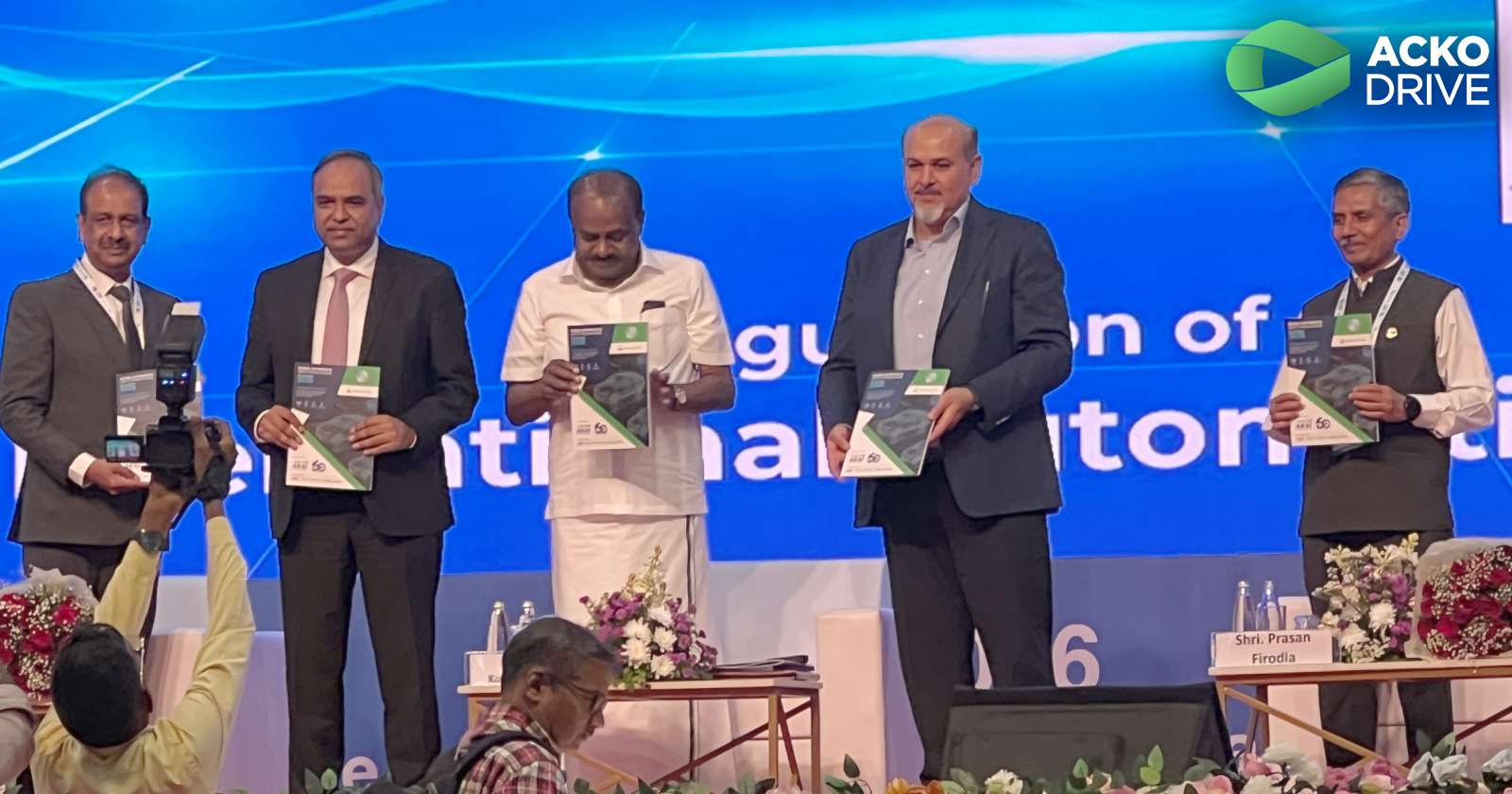
The Automotive Research Association of India, now in its 60th year, has kicked off the 19th edition of its annual Symposium on International Automotive Technology in association with the Society of Automotive Engineers, India. The three-day conference and exhibition, held in Pune, will see major automotive manufacturers as well as industry analysts, educators, technology service providers, policymakers, and industry bodies come together to present their latest research and offerings in the fields of automotive safety, software-defined vehicles, sustainability, AI, manufacturing, validation, and many other topics.
At the inauguration, held in Pune today, Chief Guest, Union Minister of Heavy Industries and Steel HD Kumaraswamy virtually inaugurated three new facilities at ARAI’s Mobility Research Centre at Takwe, near Pune.
The MRC will now have India’s first public-domain High Energy Impact Test facility, created to validate security barriers and highway safety systems. It will have a 1200 Kilowatt propulsion system that can accelerate vehicles weighing up to 13 tonnes to 100 kmph. The impact energy produced can go up to 3,600 Kilojoules, which can account for even extreme abuse load cases when testing the impact of heavy trucks against barriers.
ARAI describes its new ADAS Smart City Test Track and Modular Test Infrastructure System as a “new milestone in intelligent transportation testing” to increase trust in assisted driving tech and autonomous vehicles. The smart city track replicates real-world complexity including urban roads and intersections, and even has a multi-level car parking structure for indoor and outdoor parking scenario simulations. This test environment is supported by the Ministry of Heavy Industries, and is ISO compliant.
The Cylinder Certification and Testing Lab is also supported by the Ministry of Heavy Industries and can validate CNG and Hydrogen storage systems from Type I – IV, covering a pressure range of 200 – 700 bars. Export-grade certification will strengthen the Make in India movement, according to ARAI.
Minister HD Kumaraswamy, in his inauguration address, spoke about the growth of the Indian automotive industry, both for domestic sales and exports. “India’s automotive industry stands today as one of the fastest growing in the world, and it plays a critical role in driving our nation’s economic momentum. We are now the world’s fourth-largest economy with a GDP of 4.18 trillion US Dollars, and we are firmly on course to become the third largest by 2030. Our economy is projected to be 7.3 trillion US Dollars, in a reflection of India’s growing confidence and capability”, he said.
The minister also noted that India has set an ambitious target to achieve net-zero emissions by 2070 and spoke about various government schemes to promote the automotive industry. The government has prioritised a transition to electric vehicles with over 16.71 lakh electric vehicles purchased and 9,000 public charging stations allocated across India so far thanks to the ₹11,500 crore FAME-II scheme, and a further ₹10,900 crore allocated through the PM E-Drive scheme to incentivise charging infrastructure and EV adoption. The Production Linked Incentive (PLI) Auto scheme, with an outlay of ₹25,938 crore, is also promoting domestic and export value addition in the sector.
At the event, the minister also launched three publications, the 2026 Symposium Proceedings; ARAI Technical Reference Bulletin, 10th Edition; and 2026 Global Automotive Safety Regulations in a Nutshell, 8th Edition. Finally, he handed over the first electric truck entry category certificate under the government’s PLI Auto scheme to Tata Motors.