
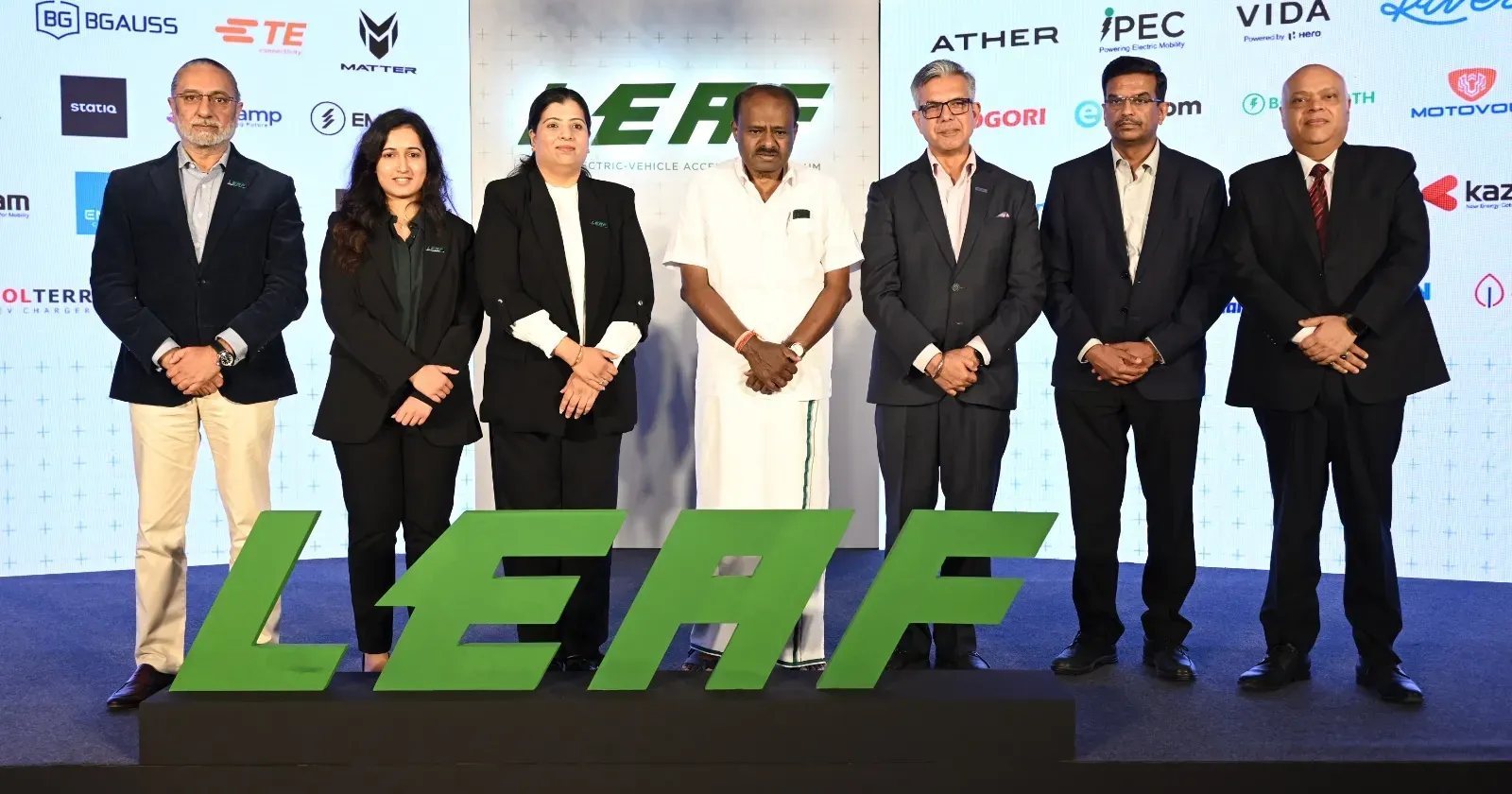
The ultimate objective of LEAF Consortium is to address all challenges by bringing all stakeholders in the EV space including policymakers, regulators, and industry bodies under one roof.



Share Post
The ultimate objective of LEAF Consortium is to address all challenges by bringing all stakeholders in the EV space including policymakers, regulators, and industry bodies under one roof.
India’s electric vehicle ecosystem took a significant step forward with the launch of the Light Electric-Vehicle Acceleration Forum (LEAF) — an industry-led consortium aimed at strengthening the country’s charging infrastructure and accelerating EV adoption. The initiative is set to bring together a wide range of stakeholders to address one of the most persistent barriers in the EV journey — Charging.
The forum, inaugurated by the Union Minister for Heavy Industries H. D. Kumaraswamy, signals a coordinated push at a time when global EV momentum has shown signs of slowing. While international markets recalibrate, India appears to be doubling down on collaboration and standardisation.
The launch of LEAF comes against the backdrop of a global EV slowdown where OEMs across the world are pulling back on their ambitions. Yet, rather than mirroring this caution, India’s approach appears more solution-oriented. During a panel discussion, representatives from LEAF’s founding members — Ather Energy, Hero MotoCorp (Vida), and IPEC —r eframed current challenges not as setbacks, but as structural gaps that must be addressed to unlock the next phase of growth.
Speaking to Acko Drive on the sidelines of the launch of LEAF, Kausalya Nandkumar, Chief Business Officer, VIDA Electric, emphasized this perspective, stating, “When you talk about headwinds, I would frame it as barriers to adoption.” At the heart of LEAF’s agenda is the development of a robust and accessible charging ecosystem.
Charging anxiety continues to be a key concern for users, particularly in the two- and three-wheeler segments that dominate India’s EV market. The consortium aims to tackle this issue holistically. As highlighted in the discussion one of the barriers is charging, which is what LEAF attempts to do. The focus extends beyond simply adding more charging points — it includes improving reliability, accessibility, and user experience across both public and private networks.
The panel further underscored the objective, noting that LEAF will work to “expand public access to charging infrastructure” and ensure “reliability and consistency of the user experience.”
A defining feature of LEAF is its emphasis on interoperability — ensuring that EV users can seamlessly access different charging networks without friction. This is particularly critical in a fragmented ecosystem where inconsistent standards have historically hindered adoption.
“Interoperability is a critical driver for success,” said Zohra Khan, Chief Executive Officer, IPEC pointing to the need for unified systems. The introduction and adoption of standards such as the Type 7 connector — approved by the Bureau of Indian Standards — represent important progress in this direction.
However, standardisation is not merely a technical exercise. It requires alignment across a complex value chain that includes OEMs, technology providers, charging operators, and even the power grid. LEAF aims to act as a platform where these interdependencies can be addressed collectively.
Unlike isolated initiatives, LEAF is designed as a neutral, industry-led platform. It brings together OEMs, charging infrastructure providers, software companies, and energy players under one umbrella.
“We’re open to not just vehicle OEMs, but also charging OEMs, technology providers, CPOs, even energy companies,” explained Khan, highlighting the forum’s inclusive structure. This diversity is already visible, with over 20 member organisations joining at launch, spanning multiple segments of the EV ecosystem.
The collaborative model is intentional. Rather than being driven by a few dominant players, LEAF aims to foster an “overall industry-led effort,” enabling broader participation and shared ownership of outcomes.
Also READ: Aadhaar Now Mandatory for EV Subsidies Under PM E-DRIVE Scheme
Another notable aspect of LEAF is its focus on accessibility — not just for established companies, but also for new entrants. The platform is positioned as an enabler, helping participants navigate the complexities of EV infrastructure and standards.
As explained during the panel discussion, new players can join through the platform and gain insights into what it takes to build a network of this sort. This includes understanding regulatory requirements, technical standards, and operational considerations. By lowering entry barriers, LEAF aims to accelerate innovation and competition within the sector, ensuring that growth is not limited to a handful of incumbents.
This development comes at a critical juncture in India's EV market. Adoption is moving beyond early adopters toward the mass market, making consistency and reliability more important than ever. “EV adoption in India has reached an inflection point,” noted Ravneet Phokela, Chief Business Officer, Ather Energy. He added that the next phase will depend on addressing “fragmented networks and inconsistent experiences.”
This transition underscores the importance of initiatives like LEAF, which aim to create a cohesive and scalable ecosystem capable of supporting large-scale adoption.
Looking forward, LEAF plans to expand its membership and deepen its engagement with policymakers, regulators, and industry bodies. Its long-term goal is to position India as a global leader in light electric mobility by building a unified charging ecosystem. There is also a clear recognition that solving for user experience will be key. The founding members have urged all stakeholders to come together and provide actual solutions for better user experience. This collective approach may well determine how quickly and effectively India transitions to electric mobility.

Mahindra Files Design Patent For Vision S Production SUV
Team Ackodrive 5 Oct, 2026, 11:29 AM IST
Mahindra's Electric SUVs Cross 1 Lakh Billings in Under Two Years
Ameya Naik 5 Oct, 2026, 11:26 AM IST
JLR Wholesales Climb 25% In Q2 As Tata Motors Arm Recovers From Cyberattack
Ameya Naik 5 Oct, 2026, 11:09 AM IST
Honda Car India to Halve Development Times, Cut Costs via Deal with Tata Technologies: Report
Acko Drive Team 5 Oct, 2026, 10:45 AM IST
E3 Electric.Ai Starts Production Of E3 TRION Electric Scooter in Hyderabad
Acko Drive Team 5 Oct, 2026, 9:56 AM IST

Looking for a new car?
We promise the best car deals and earliest delivery!
