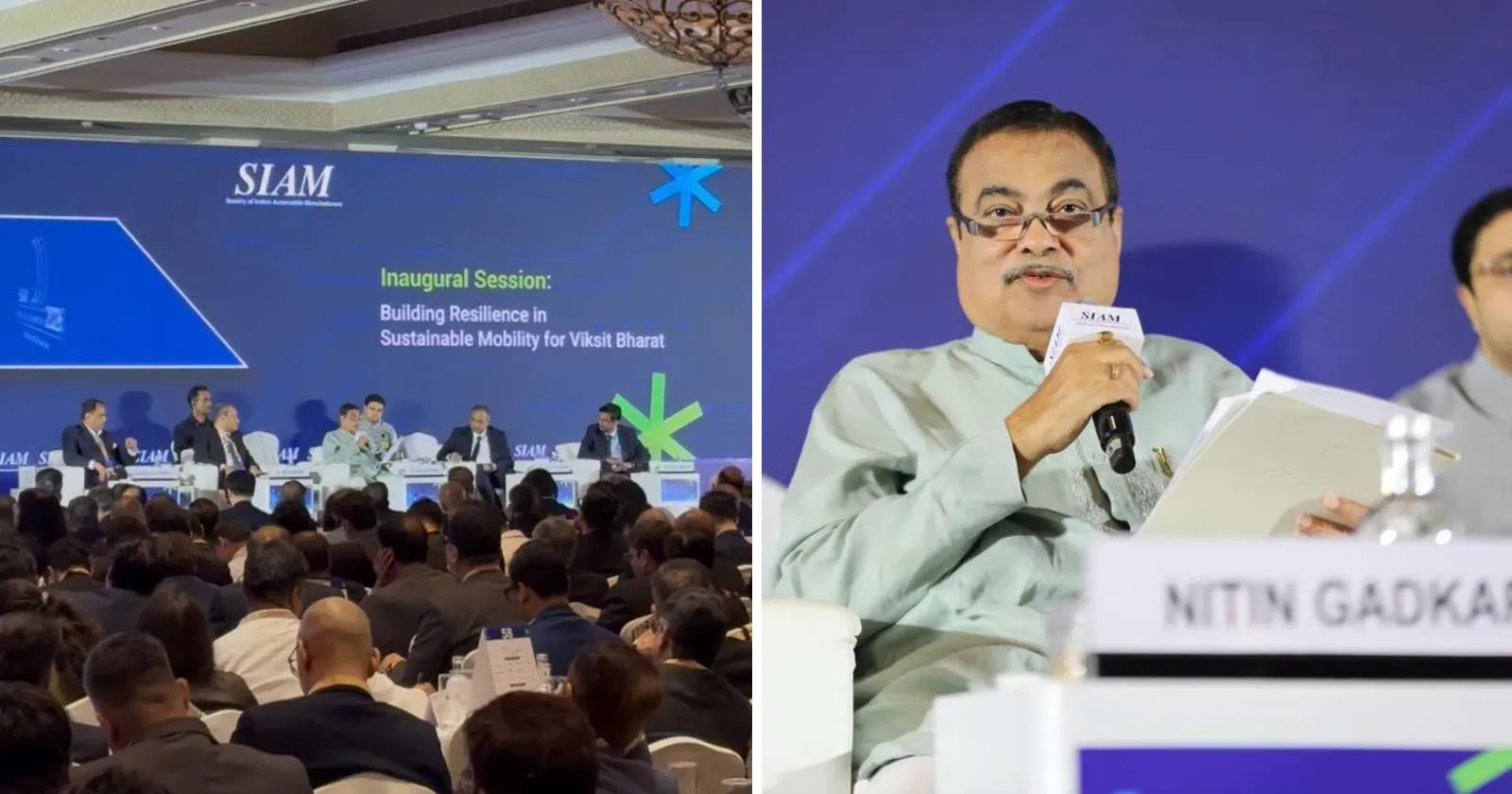
The minister also called on the industry to establish driver training centres to promote safety and keep up with demand as the country's economy grows.

Share Post

The minister also called on the industry to establish driver training centres to promote safety and keep up with demand as the country's economy grows.
Union Minister for Road Transport and Highways Minister Nitin Gadkari spoke at hte inaugural session of the 66th Annual SIAM Convention in New Delhi today, touching upon major government initiatives related to safety and sustainable mobility.
In his opening remarks, Gadkari stated that the size of the automobile industry in India is currently ₹22.75 lakh crore making it the world's third-largest overall. India is not only the world’s largest two-wheeler market but also the second-largest three-wheeler market, second-largest commercial vehicle market, and third-largest passenger vehicle market. The country’s automobile exports are worth ₹4 lakh crore, increasing by 24 percent in FY 2025-26.
The automobile industry contributes 15 percent of all GST collected, and road tax brings in ₹1 lakh crore, and has also created approximately 4 crore direct and indirect jobs. Gadkari also said the world market has shown India a tremendous response, and it has the potential to become the number one auto industry in the world.
Hailing India’s BNCAP as a global success story, Gadkari said its operations are possible not only because of the Government’s efforts, but also cooperation and coordination from the industry. Over 30 models from 11 companies have been tested so far. Interestingly, Gadkari said it costs manufacturers around ₹2.5 crore to have each model tested and certified by Global NCAP, but only ₹60 lakhs at BNCAP. He also suggested that multiple foreign companies have expressed interest in sending their vehicles here for testing.
Bharat NCAP allows companies to show that they have achieved standards for safety, which is one reason that the export market is responding positively, according to Gadkari, who said honesty, credibility, and goodwill is the biggest capital of the 21st century. He added that BNCAP has increased the value of the Indian automotive industry.
The previously announced BNCAP 2.0 protocol will come into effect in October 2027 and will extend evaluation to the entire safety channel. In line with other countries’ NCAP agencies, BNCAP will move towards including crash avoidance, passenger protection, pedestrian protection, and post-crash evacuation and care.
Gadkari stated that India is number one in the world in terms of road accidents. Every year, there are 5 lakh accidents resulting in 1.8 lakh deaths. Moreover, 66 percent of deaths are of people aged 18-36, which is a huge problem for the country. The death toll has to be reduced “at any cost”, he said, adding that the industry needs to cooperate and adopt better technology and newer safety standards.
He also praised Indian startups for the cost-effective technology they are developing, and invited suggestions from key industry figures present in the audience to help ensure safety.
Driver behaviour is also a big problem, Gadkari stated. The ministry is planning to introduce a graded point system for driving licenses and vehicle registration certificates. Calling this an important scheme, the minister said every offense will result in points being cut, and after a certain limit, licenses will automatically be suspended or possibly cancelled. People who keep making mistakes need to correct their behaviour. It will also be possible to earn points for good driving, which can be used to avail benefits on insurance or other relevant goods and services. The minister said this will encourage responsible driving behaviour.
Gadkari also called for the industry to set up more driver training centres, saying there is a national shortage of qualified drivers. At present, 1,600 government driving training centres are set to be established, of which 24 are currently operational and 112 confirmed to be in the pipeline. Ten lakh drivers have been trained as of now, but the annual capacity will soon be 1.5 lakh crore drivers.
Gadkari also pointed out a lack of adequate training for commercial vehicle drivers, particularly those who operate construction equipment, saying there are no formal provisions for training them at all. Given the demand across India, he said socio-economically backward regions could benefit from such facilities.
He then called on automakers to take this up as a CSR initiative, pointing out that they benefit immensely from the government’s spending on roads and highways. As tourism increases and the economy grows, thousands of new commercial vehicle and bus drivers will be needed across the country.
Nitin Gadkari Confirms BNCAP 2.0 Protocol Details, Plans for Drivers License Points System
Jamshed Avari 3 Sept, 2026, 2:18 PM IST
Tata Curvv Series X Launched Starting at ₹9.99 Lakh
Tushaar Singh Gill 3 Sept, 2026, 8:57 AM IST
Maruti Suzuki Becomes India’s Largest EV Exporter: Over 46,000 e Vitara Units Exported Since Launch
Acko Drive Team 3 Sept, 2026, 8:49 AM IST
Government Approves AIS 228 Standards for Emission Control Retrofitting
Acko Drive Team 3 Sept, 2026, 8:02 AM IST
India’s Auto Component Sector Targets $200 Billion Turnover: BCG-ACMA Report
Acko Drive Team 3 Sept, 2026, 7:19 AM IST
Looking for a new car?
We promise the best car deals and earliest delivery!