

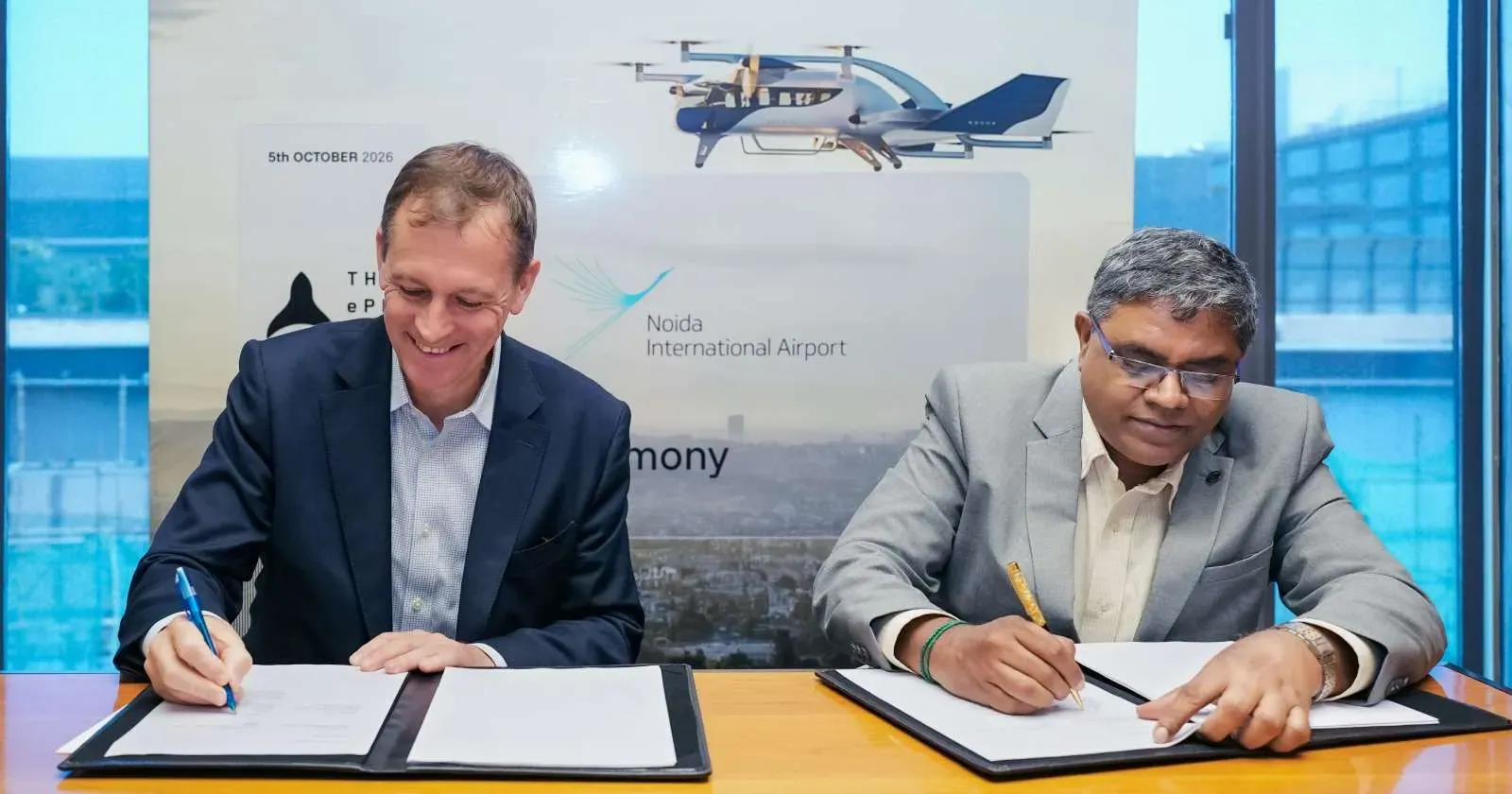
Daniel Bircher, Managing Director at Zurich Airport International (left), and Satya Chakravarthy, Founder and Technical Lead, The ePlane Company (right) signing the MoU.
Chennai-based electric flying taxi startup The ePlane Company has signed a Memorandum of Understanding with Noida International Airport as it works toward deploying its upcoming e200X aircraft as a flying taxi. The company is currently conducting ground tests, with flight tests set to begin before the end of this year.
The MoU aims to establish a framework to co-develop regulatory standard operating procedures (SOPs), Vertiport Management Systems, and the operational ecosystem needed for ePlane’s e200X aircraft to be deployed as a flying taxi. Initially, the company envisions use cases such as airport-to-airport transit and intra-city commutes. The e200X will also be configurable as an emergency air ambulance, and for cargo transportation.
The ePlane Company, founded in 2019 and incubated at IIT Madras, recently unveiled its first full-scale prototype of the e200X, and claims it has made significant engineering progress. With this MoU, airport operations and airspace integration will progress alongside further development and testing of the aircraft. The company is also currently working on obtaining clearance from the Directorate General of Civil Aviation (DGCA) and Bureau of Civil Aviation Security (BCAS).
Noida International Airport is operated by Yamuna International Airport Private Ltd (YIAPL), a subsidiary of Zurich Airport International AG. It will allocate space to The ePlane Company to conduct proof-of-concept trials, set up vertiports for vertical takeoff and landing, and charging stations. Both partners will engage with regulatory authorities and develop SOPs for air traffic control (ATC), safety, vertiport management, and scheduling. The ePlane Company says it will use AI to help with fleet scheduling, integrated with smart city systems.
In a statement, Dr Satyanarayanan Chakravarthy, Founder and Director of Ubifly Technologies (The ePlane Company) said “Deploying electric air taxis requires more than just building the aircraft; it demands the parallel development of ground infrastructure, regulatory frameworks, and operational procedures. This MoU with Noida International Airport allows us to systematically validate our operational models using drone trials before transitioning to piloted e200X flights. It is a pragmatic, step-by-step approach to ensuring that when our aircraft are certified, the airport ecosystem is fully equipped to deliver on our core promise: bypassing urban gridlock and compressing hours of road travel into minutes of safe, emission-free transit for both passengers and critical medical care.”
Daniel Bircher, Chairman, Noida International Airport, said “Noida International Airport’s long-term vision is closely linked with bringing innovative, future-ready infrastructure to the region. Integrating advanced air mobility into our airport framework is an important part of our commitment to seamless, multi-modal connectivity.”
The ePlane Company says it operates India’s first and only integrated electric vertical takeoff and landing (eVTOL) prototyping, manufacturing, and testing facility, spread across 60,000 square feet. It was the country’s first private aerospace firm to receive a formal Design Organisation Approval (DOA) from the DGCA for electric aircraft.
The e200X is the first eVTOL aircraft accepted into the DGCA’s official type certification pipeline. In its tech demo stage, it has undergone 10,000+ km of cumulative flight testing. It will be aimed at zero-emission travel in high-density urban corridors. The modular airframe, built using 10 independent propulsion units, is designed to be ultra-compact with an 8m x 11m footprint, allowing for use on common urban rooftops and standard helipads. It will have a 160 kmph cruise speed and 110 km range per charge.
With no tilting parts, the “Synergistic Lift Propulsion” system is designed for stability and redundancy. The e200X features a proprietary battery management system, as well as in-house software and sensor stacks. Safety systems include an integrated ballistic parachute, independent cruise and glide fallback capabilities, a crash-safe fuselage, and crashworthy energy-absorbing seats.