

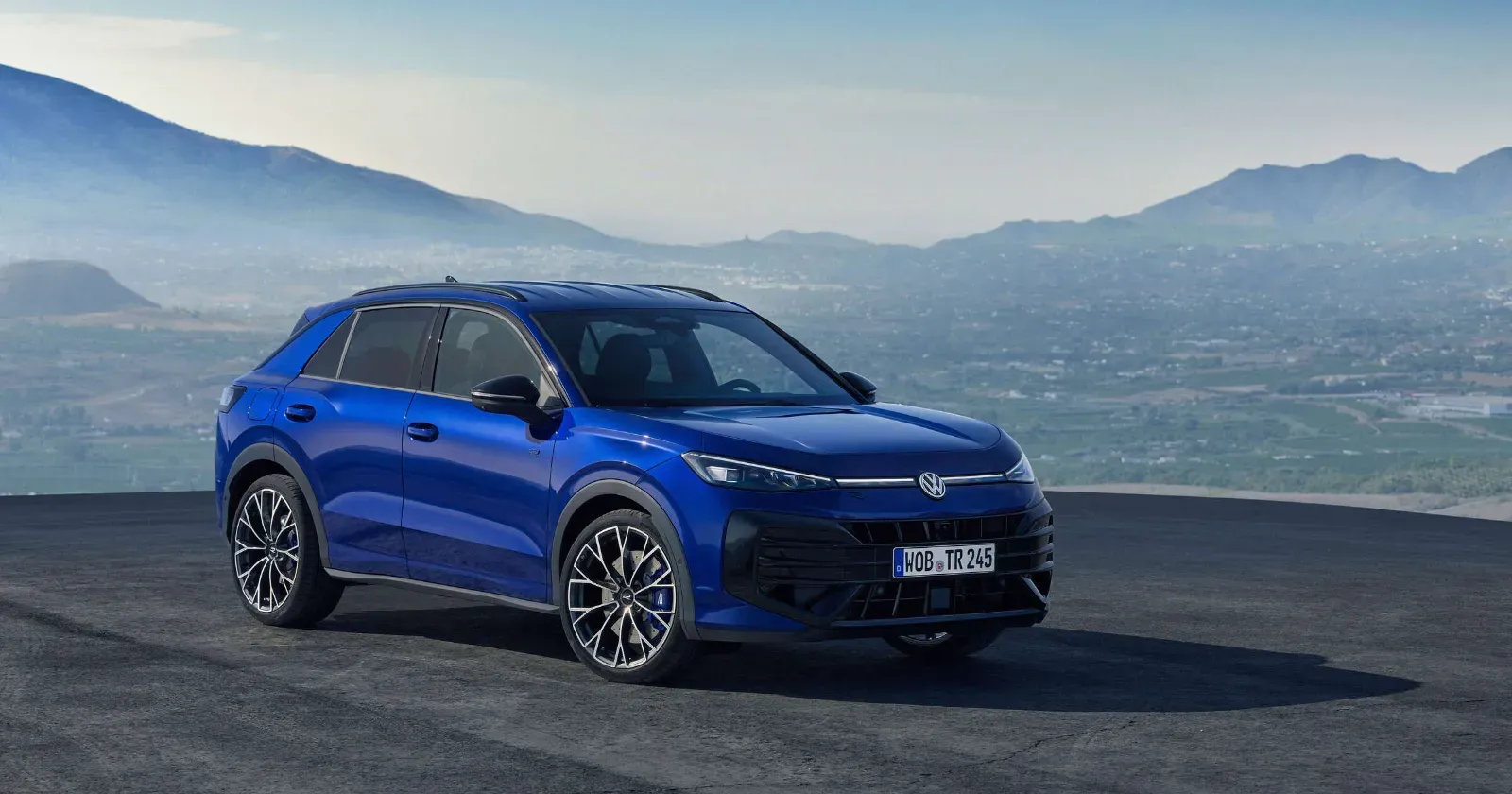
Volkswagen has unveiled the new T-Roc R, a performance version of its compact SUV that the company describes as the most powerful SUV currently in its European line-up. The model had its world premiere on Wednesday, a year after the standard T-Roc went on sale, and European pre-sales begin on Thursday with prices starting at €59,995 in Germany.
At the heart of the car is a newly developed 2.0-litre turbocharged petrol engine paired with 48-volt mild-hybrid assistance, producing 245 kW (333 PS) and 420 Nm of torque. Volkswagen says an electrically driven compressor, part of the 48-volt system, boosts torque at low engine speeds, smoothing out power delivery before the turbocharger fully spools up. The engine is mated to a seven-speed direct-shift gearbox and the company's 4MOTION all-wheel-drive system, enabling a claimed 0-100 km/h time of five seconds and an electronically capped top speed of 250 km/h. It is the first time Volkswagen's R performance division has used 48-volt hybrid technology, which the company says also enables stronger brake energy recovery and coasting with the engine switched off to save fuel.
Also read: Targeting Premium Car Buyers, BMW To Launch Luxury Alpina Brand In India Next Year
The all-wheel-drive system itself has been reworked with what Volkswagen calls R-Performance torque vectoring, built around a rear differential — the torque splitter — that distributes power between the axles and between the two rear wheels independently. A new software calibration is aimed at improving stability under braking and acceleration when grip differs between the left and right sides of the road, a scenario known as µ-split. Driving modes include a dedicated Race setting, along with Special and Drift profiles, the former tuned for the Nürburgring Nordschleife and the latter designed to replicate the handling character of all-wheel-drive rally cars on closed circuits.
Standard equipment includes adaptive DCC suspension, progressive steering, 19-inch wheels, a four-pipe exhaust system and an R-specific instrument display showing lap times and torque distribution; a titanium Akrapovič exhaust and 20-inch forged wheels are offered as options.
The T-Roc R is not expected in India, where Volkswagen's SUV strategy remains centred on the Taigun and the newer Tiguan, both aimed at volume rather than outright performance. India's enthusiast-oriented SUV buyers currently have few direct options from mainstream manufacturers, with performance variants largely confined to hot hatches and a handful of imported models. Even so, such global unveilings matter to the domestic market as a signal of engineering direction — 48-volt hybrid systems and sophisticated torque-vectoring hardware of this kind tend to filter down to mainstream models over time, an area Indian manufacturers are also beginning to explore as emission norms tighten and electrification gathers pace. For now, the T-Roc R remains a European-market proposition, with deliveries expected to follow pre-sales into next year.