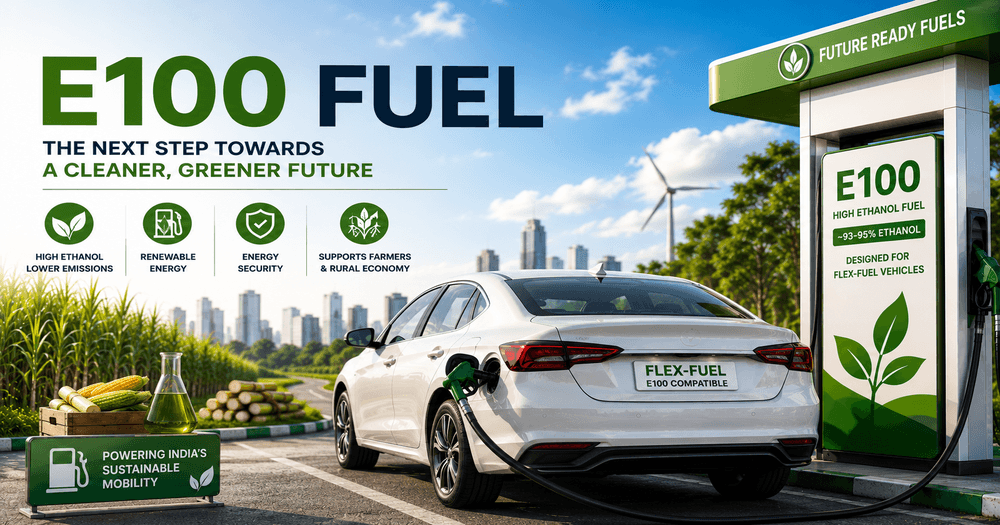
What Is E100 Fuel?
E100 fuel is a high-ethanol fuel made mainly for specially designed flex-fuel vehicles. Despite its name, it is not 100% pure ethanol. It usually contains around 93-95% ethanol, 5-7% petrol, and additives that improve performance and cold-weather starting. Ethanol itself is a renewable fuel produced from agricultural feedstocks such as sugarcane, maize, and biomass. Compared with petrol and lower ethanol blends such as E20 and E85, E100 has the highest ethanol concentration.
Since E100 fuel has different chemical properties from petrol, it can only be used in specially designed flex-fuel vehicles equipped with ethanol-compatible components and fuel systems.
E85 Fuel vs E100 Fuel: What's the Difference?
Although both E85 and E100 are high-ethanol fuel blends, they differ in ethanol concentration, vehicle compatibility and availability. Here's a quick comparison between the two:
Parameter | E85 Fuel | E100 Fuel |
Ethanol content | 85% | Approx. 93-95% |
Petrol content | 15% | 5-7% with additives |
Vehicle compatibility | Flex-fuel vehicles (FFVs) | Specially designed flex-fuel vehicles |
Fuel efficiency | Lower than petrol | Lower than E85 and petrol |
Availability in India | Limited | Not commercially available |
Which Vehicles Are Compatible With E100 Fuel?
Unlike conventional petrol, E100 fuel requires specially designed flex-fuel vehicles with ethanol-compatible fuel systems and components that can withstand high ethanol concentrations. These vehicles use specialised fuel lines, corrosion-resistant materials, specially calibrated fuel injectors, and advanced engine control units (ECUs) to adjust engine operation based on the fuel being used. These modifications allow the vehicle to handle high ethanol levels safely and maintain reliable performance.
Because ethanol contains less energy than petrol, E100-powered vehicles may consume more fuel to cover the same distance. To support efficient operation, E100 also contains additives that help improve starting, combustion and overall driving performance
Benefits of E100 Fuel
E100 fuel offers several advantages and could become an important component of future biofuel strategies. Some of its key benefits include:
Reduced Dependence on Fossil Fuels
Since ethanol can be produced domestically, E100 fuel can help reduce reliance on imported crude oil and strengthen energy security.
Lower Environmental Impact
Derived from renewable sources, E100 fuel is considered a cleaner alternative to conventional petrol and can help reduce carbon emissions.
Supports Agriculture and Rural Economy
Higher ethanol demand can create additional opportunities for farmers and encourage investments across the biofuel ecosystem, including storage, logistics and processing.
Encourages Biofuel Innovation
The development of E100-compatible vehicles and infrastructure can support advancements in flex-fuel technologies and encourage further innovation in alternative fuels.
Limitations of E100 Fuel
Despite its potential advantages, E100 fuel also faces several challenges that may limit its widespread adoption.
Lower Fuel Efficiency
Since ethanol contains less energy than petrol, vehicles running on E100 fuel may deliver lower mileage and consume more fuel.
Vehicle Compatibility
Regular petrol vehicles are not designed to run on E100 fuel. It requires specially engineered flex-fuel vehicles equipped with ethanol-compatible components.
Limited Fuel Infrastructure
Unlike E20 petrol, E100 fuel is not commercially available in India at present. While the country has introduced E85 fuel on a limited scale and continues to expand its ethanol ecosystem, supporting infrastructure for E100 fuel has not yet been rolled out for large-scale adoption.
Limited Consumer Awareness
E100 fuel and flex-fuel technology are still relatively unfamiliar to many consumers, which could slow down adoption.
Where Is E100 Fuel Used?
Brazil is considered the world's largest and most mature market for ethanol-based fuels and has used E100 for decades. The country has a well-developed flex-fuel ecosystem supported by widespread ethanol availability and dedicated vehicle technologies.
Apart from Brazil, countries such as the United States, Sweden and Thailand have also promoted ethanol-based fuels, although the use of pure E100 fuel remains relatively limited compared to Brazil.
E100 Fuel in India: Present and Future
India's immediate focus remains on E20 petrol and the gradual development of higher ethanol blends. The country has also approved a regulatory framework for the homologation and sale of E100 fuel, signalling its intent to support flex-fuel technologies in the future. IndianOil has already established E100 dispensing stations in select cities across states such as Maharashtra, Uttar Pradesh and Delhi.
In the long term, E100 fuel could complement other clean mobility solutions such as electric vehicles, hybrids and CNG vehicles. However, its widespread adoption will depend on infrastructure development, vehicle availability and consumer acceptance.
Frequently Asked Questions (FAQs)