

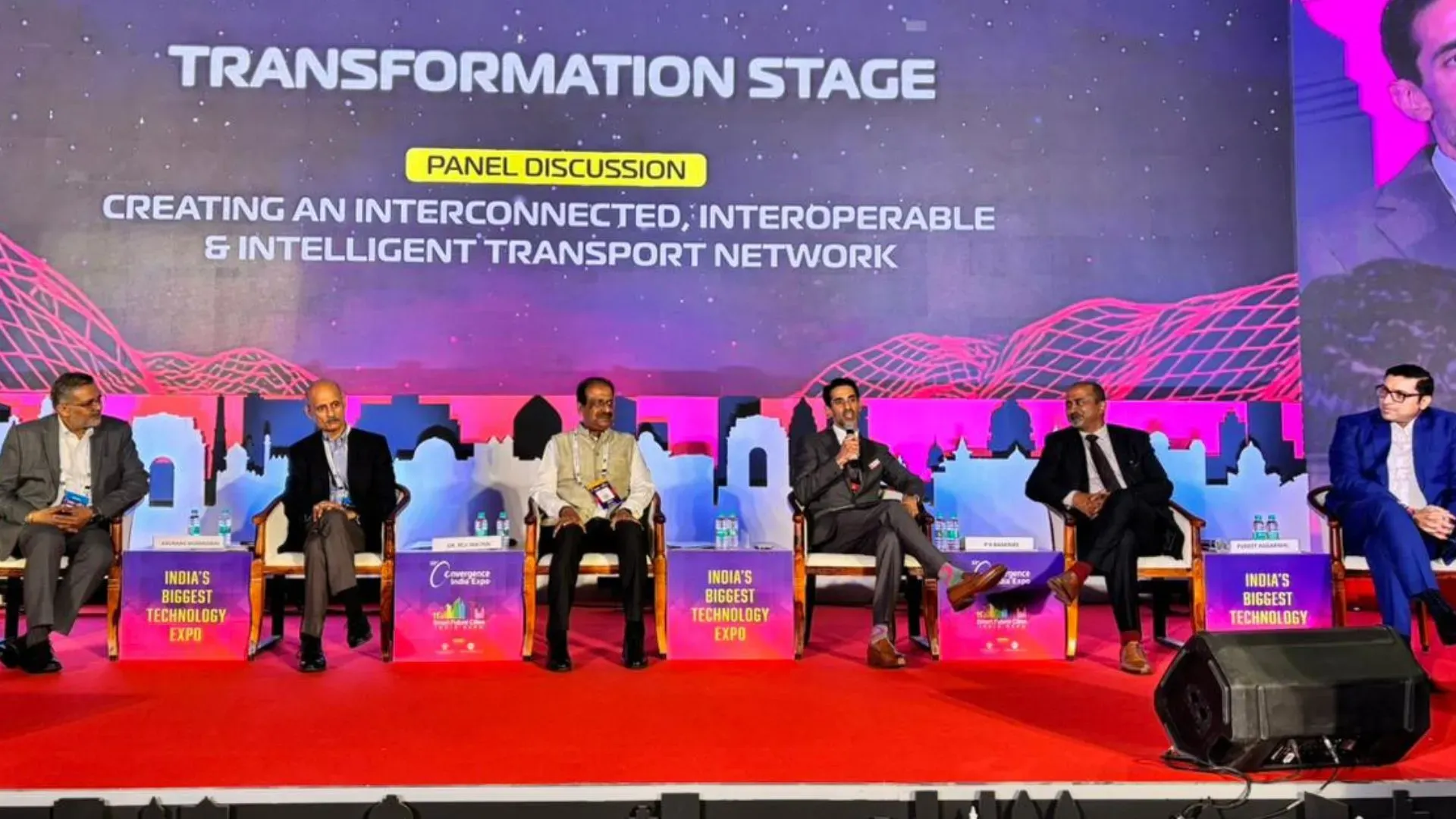
At Convergence India Expo 2026, a panel discussion on “Creating an Interconnected, Interoperable and Intelligent Transport Network” brought together senior voices from industry and regulation to chart the road ahead for smart mobility in India. The consensus was clear: connected vehicles are no longer a premium feature but a national necessity that must become the default to tackle congestion, pollution and grid challenges while unlocking genuine intelligence in the transport ecosystem.
Puneet Aggarwal, Head of Smart Mobility at Jio, set the tone by declaring that “all vehicles are going to be connected by default.” He argued that connectivity driven by safety, security and ecosystem needs should be mandated under norms such as CAFE regulations. “The control has to happen on the cloud,” he said, stressing that true autonomy lies not inside the vehicle alone but in learning from mixed data across vehicles, traffic signals, roads and EV charging infrastructure. He lamented the current OEM-specific tech and called for nodal agencies to enforce cross-sharing of data so that innovation can flourish.
Dr Reji Mathai of the Automotive Research Association of India (ARAI) reminded the audience that India is in a delicate transition phase. New technologies are being judged against systems perfected over five to six decades, and customers expect a meaningful delta in value. While V2X and connected vehicles carry strong promise, he cautioned that benefits will accrue only when the ecosystem aligns.
Also read: Maruti Suzuki Expands Rail-Based Vehicle Dispatches, Manesar Siding Reaches 1 Lakh Units
India, he said, has built a solid collaborative framework through the Automotive Industry Standards Committee where industry participates from the drafting stage. ARAI has already logged 30,000 km of Indian road data, complete with cows and chaotic traffic, and set up a 16-acre test track with realistic S-curves and ramps to validate systems locally rather than blindly adopting foreign solutions.
Then, Tarun Aggarwal, Senior Executive Officer and Head of Engineering at Maruti Suzuki, brought a pragmatic OEM perspective. He described how Maruti is not merely selling EVs but building an entire ecosystem, charging infrastructure backed by a vast dealer network. He painted a vivid picture of a typical Indian apartment society where 20 EVs plugging in simultaneously could collapse the local transformer. “Connectivity can really make sense here,” he said, explaining how smart sequencing, time-of-day tariffs and customer preferences such as fully charged by 8 am can be managed only through connected systems.
Yet, he struck a note of caution: “Connectivity itself will not solve problems. You have to do many things right together.” Pointing to Japan, the US and China, where V2X initiatives launched decades ago are still struggling for wide impact, he urged India to avoid jumping the gun. Instead, the country must identify its own wicked problems, congestion, pollution, grid constraints, run focused pilots and prototype India-specific solutions before scaling.
All speakers repeatedly returned to the “three I’s”, Interconnected, Interoperable and Intelligent. Interoperability emerged as the critical bridge: vehicles must talk to infrastructure, energy companies must coordinate with charging operators, and ministries must speak the same language. India’s diversity, described by one speaker as a “country of countries”, makes one-size-fits-all impossible, yet it also offers a historic chance to leapfrog.
Because EVs are already connected by default and younger Indians have grown up with ubiquitous mobile connectivity, the panel believes the foundation is stronger than in many mature markets. The discussion ended on a note of guarded optimism. If policy, industry and infrastructure can finally connect the dots, the panel concluded, the dream of an intelligent, interoperable transport network will be a reality on Indian roads.