
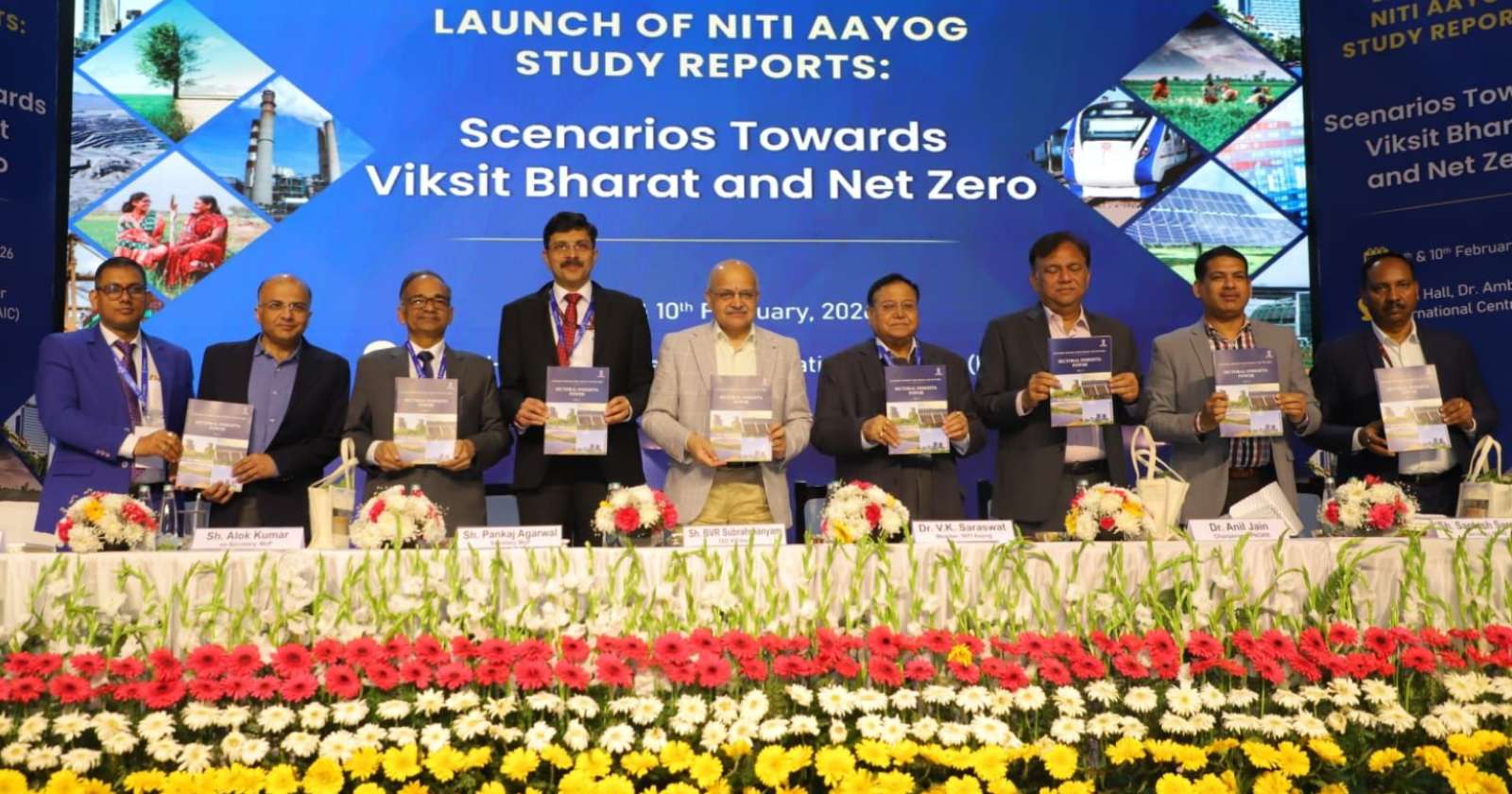
The report identifies structural shifts needed to address increased demand for passenger and freight mobility while targeting net zero emissions.


Share Post
The report identifies structural shifts needed to address increased demand for passenger and freight mobility while targeting net zero emissions.
NITI Aayog, the government’s policy thinktank, has released a set of reports aimed at various sectors of the economy, detailing its analysis of their current state and recommendations to achieve net-zero emissions. The reports identify green electrification, behavioural changes, and circularity as essential to meet the government’s “Viksit Bharat” policies, but say that this can be achieved by 2047 in all scenarios.
The four major sectors addressed are transportation, power, industry, and critical minerals. In terms of transportation, the report states that vehicles powered by electricity, biofuels, and hydrogen could meet almost 90 percent of the country’s mobility demands by 2070. Both passenger and freight transportation needs are set to increase significantly, requiring a structural shift toward public and shared mobility solutions. The report also calls for better urban planning and increased effort to develop railways and waterways as critical forms of transport.
The transportation sector accounted for 20 percent of energy demand and around 10 percent of greenhouse gas emissions in 2020, according to the report. Rapid urbanisation and increased demand will require additional fuel imports and will negatively impact air quality without a clear approach to decarbonisation and transitioning to cleaner fuels. Moreover, the agency says adopting its recommendations could help the development of new industries and create jobs to serve demand for batteries, charging infrastructure, recycling and more.
NITI Aayog projects that the share of petroleum-powered vehicles could be reduced to around 21 percent by 2070, with hydrogen emerging as the primary fuel for long-haul freight and aviation. It also suggests that while natural gas plays an important role today, it can be replaced by bio-CNG.
Under its ideal scenarios, private ownership should not exceed 200 vehicles per 1,000 citizens, with public and shared transit serving around 60 percent of all passenger requirements.
Challenges that will need to be overcome include transition costs, insufficient public EV charging facilities, reliance on imported batteries and raw materials for production, connectivity and governance gaps in public transport infrastructure, and poor coordination between government agencies and the industry.
Policy suggestions include prioritising the adoption of EVs as well as biofuel and biogas-powered vehicles, expanding charging and battery swapping infrastructure, enforcing building codes, and improving adoption of India’s Unified Energy Interface (UEI) for smart charging and price optimisation. Aggregated procurement is recommended for high-use fleets of buses and taxis. Moreover, production-linked incentives (PLIs) are needed to boost the local manufacturing of batteries and strengthen the EV supply chain.
Metro railways and regional rapid transit networks, premium bus services, and last-mile connectivity to transit points need to be developed, along with encouraging walking and cycling with appropriate civic infrastructure. Simultaneously, congestion surcharges and parking fees can be leveraged to discourage private passenger and freight movement.
Along with the transportation sector, the reports address energy production and efficiency. NITI Aayog suggests lowering total energy demand by 20 percent by 2070, and using recycling to meet at least 20 percent of demand for copper and graphite by 2050. Demand for steel, aluminium and cement are likely to increase sixfold by 2070, and electricity use will also rise sharply because of urbanisation, cooling needs, digitalisation, and electric mobility. This will require a shift to greener energy sources such as hydrogen and renewables.

TVS Becomes Third-Largest Two-Wheeler Manufacturer in the World
Acko Drive Team 4 Mar, 2026, 12:41 PM IST
5 Interesting Colour Options On Indian Cars
Acko Drive Team 4 Mar, 2026, 12:30 PM IST
Actor Shahid Kapoor Brings Home Mercedes-Benz G 450d Worth ₹2.9 crore
Acko Drive Team 4 Mar, 2026, 10:20 AM IST
Volvo Brings New UX to 2.5 Million Older Cars With its “Largest OTA Software Update Ever”
Acko Drive Team 4 Mar, 2026, 9:27 AM IST
Renault Teases Bridger Subcompact SUV Concept To Take On Hyundai Venue, Will Be Made In India
Acko Drive Team 4 Mar, 2026, 8:52 AM IST

Looking for a new car?
We promise the best car deals and earliest delivery!
