
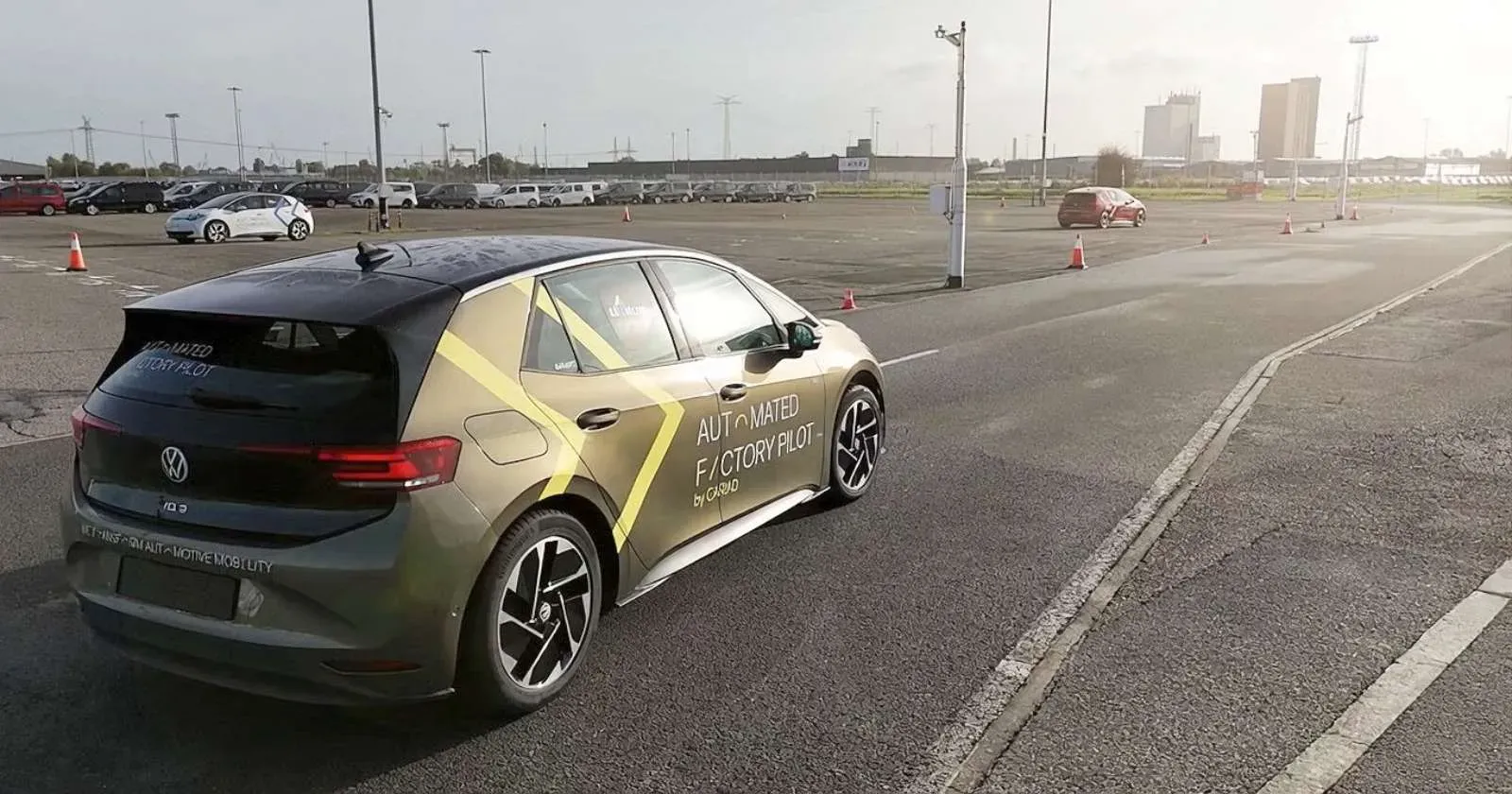
A two-year project that tested how autonomous vehicles interact with current-day human drivers in a real-world commercial workflow situation has come to an end. Volkswagen, cellular operator Deutsche Telekom, Finnish tech company Unikie ,and the Bremen Institute for Production and Logistics at the University of Bremen (BIBA), worked together to study autonomous vehicle movement at the port of Emden, in north Germany. The researchers say that the study has generated valuable insights for future development of autonomous vehicles and logistics solutions.
The two-year study, called AutoLog, combined vehicles from Volkswagen, 5G networking from Deutsche Telekom, vehicle control and management technology from Unikie, and research conducted by BIBA. The study was funded by Germany’s Federal Ministry of Transport.
The movement of autonomous vehicles within the Emden port area was studied to help learn how to integrate them safely, efficiently, and sustainably into existing logistics handling processes.
Compute operations used an edge cloud system with dedicated high-speed fibre optic communications and 5G wireless links to the moving vehicles. The test site included parking areas and defined driving routes including a busy roundabout, which were recreated digitally to support vehicle movement training and coordination.
The AutoLog project was used to prove multiple technology components across environment perception, communications infrastructure, coordination, and the vehicles themselves. These will all have to work together reliably to form integrated systems for autonomous vehicle logistics. The team also studied the suitability of standard communication infrastructure, and safe interaction between people and technology.
Additionally, Volkswagen Group company Audi worked with the AutoLog project to test how vehicles can be loaded precisely onto rail wagons for shipping, another aspect where autonomous driving can intersect with logistics. The company also runs other real-world research and development projects related to autonomous vehicle technology, though it has recently terminated some efforts in the space.
Christian Vollmer, Board Member of the Volkswagen Passenger Cars brand responsible for Production and Logistics, said “AutoLog demonstrates the potential of autonomous driving for our logistics operations. For us, the key is not just to develop new technologies under laboratory conditions, but to test their practical suitability where our logistics operations take place every day. Together with our partners in Emden, we have gained valuable insights into how vehicle movements can be automated more intelligently and logistics processes further developed in the future. We intend to draw on this experience as we continue to develop the technology.”
Klaus Werner, Managing Director of Business Customers at Telekom Deutschland, said “AutoLog demonstrates how industry-ready connectivity can form the digital backbone for automated processes throughout vehicle logistics. The combination of low-latency, reliable connectivity, edge infrastructure, and intelligent vehicle control creates the technical foundation for scaling automated vehicle distribution from the end of the production line via rail and ship to the end customer.”