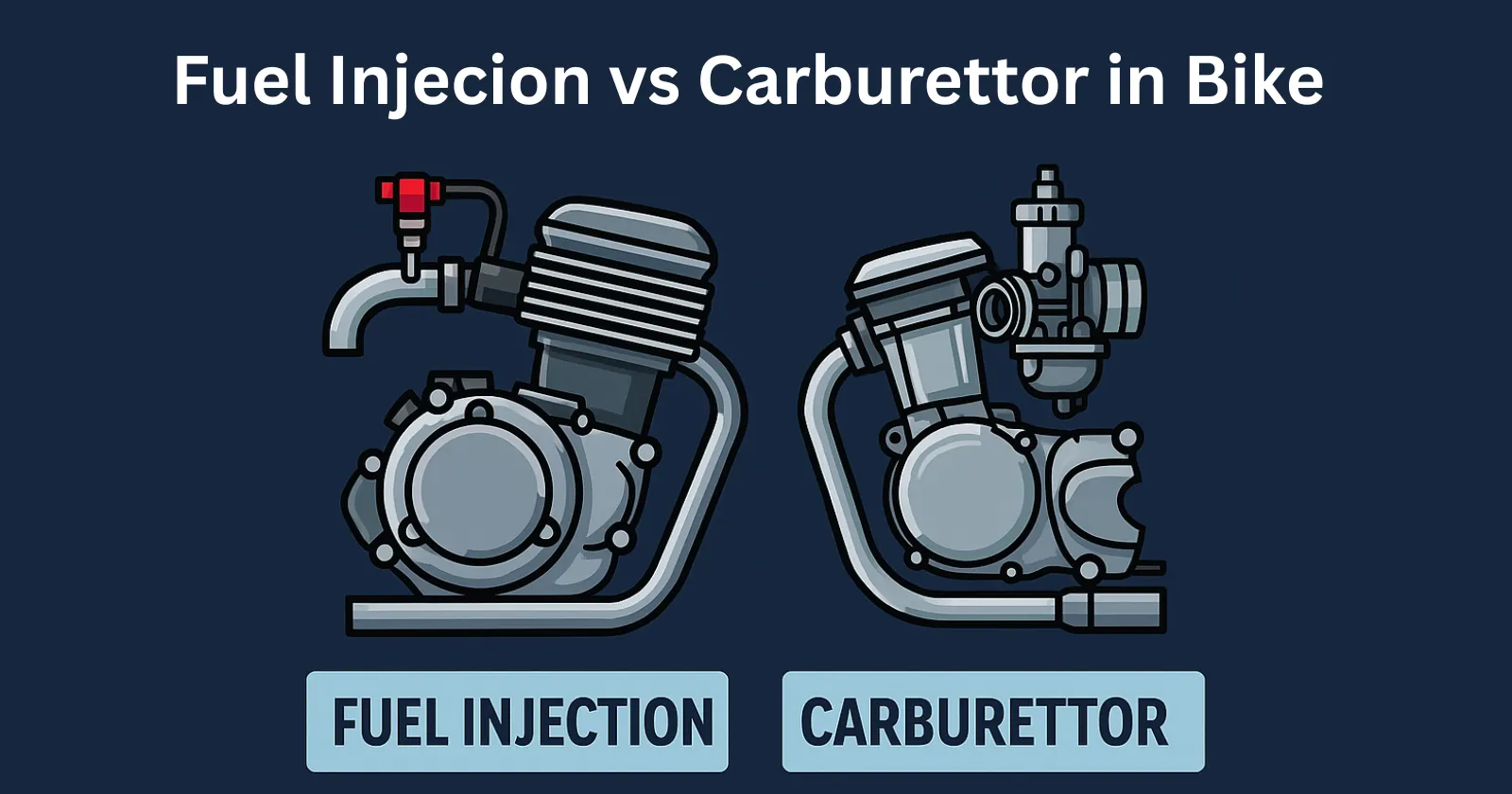
What is Fuel Injection in Bikes?
A fuel-injection system in bikes uses electronic sensors and a computer (ECU) to spray the exact amount of petrol into the engine. Here’s how it works.
- Sensors measure air temperature, engine temperature, throttle position, and other factors.
- The ECU calculates how much fuel to deliver and when to trigger the injector.
- A small nozzle injects fine petrol spray directly into the intake or combustion chamber.
- This delivers the right mixture every time, for smoother riding and better fuel economy.
What is a Carburettor in Bikes?
A carburettor in bikes is a mechanical device that mixes petrol with air before it enters the engine. Here’s how things work inside a carburettor:
- Air flows through a narrow tube and pulls petrol from a small bowl or float chamber.
- The mixture of air and petrol gets atomised (turned into fine droplets) before entering the engine's cylinder.
- A simple butterfly valve or throttle controls how much mixture goes in.
Difference Between Fuel Injection and Carburettor in Bikes
| Feature | Fuel Injection | Carburettor |
| Fuel Delivery Method | Uses sensors and ECU to control fuel flow | Uses air suction and manual tuning |
| Fuel Efficiency | More fuel-efficient | Less fuel-efficient |
| Emission Control | Lower emissions, meets BS6 norms | Higher emissions |
| Starting in Cold Weather | Starts easily without choke | May need a choke or warming up |
| Maintenance | Low maintenance, needs authorised service | Easy to clean, can be fixed by local mechanics |
| Performance | Smoother and consistent across terrains | Can vary with temperature and altitude |
| Cost | More expensive | Less expensive |
| Used In | Modern bikes (BS6 and above) | Older or entry-level bikes |
Pros and Cons of Fuel Injection and Carburettor in Bikes
Pros of Fuel Injection in Bikes:
- More precise fuel delivery at all times
- Reliable starting even when cold or hot
- Saves fuel and produces less smoke
- Adaptable to changing weather and altitude
Pros of Carburettor in Bikes:
- Affordable to buy and fix
- A simple mechanism that mechanics across India understand
- Accepts older fuel types well
- Easy to tune manually
Cons of Fuel Injection in Bikes:
- Costs more upfront, and servicing requires trained technicians
- Sensors and the ECU can fail if not maintained
- Not ideal for older bikes with a carburettor meant for mixed fuel types
Cons of Carburettor in Bikes:
- Less precise fuel delivery, so performance can drop in hot weather or high altitude
- Requires periodic tuning and cleaning
- Prone to stalling when the engine is cold
- Slightly higher fuel consumption in city traffic
Why Does This Matter to the Rider?
In India, bikes have to perform from icy roads in Kashmir to the burning sun in Rajasthan. The fuel available, altitude, and traffic conditions vary greatly. A bike’s fuel system affects:
- How well it starts in cold or rainy monsoon mornings
- Fuel efficiency in stop-and-go city traffic
- Emissions and how clean the exhaust remains
- How weather changes, heat or dust affect engine performance
Fuel Injection vs Carburettor in Bikes: Key Differences That Affect Your Ride
Both of these fuel delivery systems work differently and have a direct impact on how smoothly your bike starts, runs, and saves fuel. Below is a step-by-step comparison of both in different aspects.
Engine Start-Up and Reliability
- Fuel Injection: It starts easily regardless of temperature or humidity, without fiddling with a choke.
- Carburettor: It may be hard to start early in the morning. You need to use a choke (or priming technique) to warm it up. In dusty or humid areas, it may stall mid-ride.
Fuel Efficiency and Emissions
- Fuel Injection: It adjusts itself based on data from sensors, resulting in better fuel efficiency and lower pollution. It helps the bike meet stricter emission norms.
- Carburettor: It can run a richer mixture (more fuel than air), leading to higher fuel consumption in city riding or when tuned poorly. It is vital to note that emissions can be higher in this.
- Fuel Injection: It maintains consistent performance across different climates and terrain. In this system, throttle response is sharp, which helps in overtaking or climbing hills.
- Carburettor: It offers decent performance when tuned correctly. However, in very hot or cold conditions or at high altitude, ride quality may suffer.
Maintenance and Repairs
- Fuel Injection: It needs special tools and sensor checks. So, it must be serviced by trained professionals at authorised service centres.
- Carburettor: It is easier to clean with simple sprays or solutions. Its spare parts are cheaper, and most local mechanics can repair it without any special tools.
Which System Suits Your Riding Style?
Different riders have different needs. Whether you ride in city traffic or go on long highway trips, choosing the right fuel system is of utmost importance.
A carburettor may be enough if:
- You ride mainly within the city (up to 100–125 cc bikes)
- You seek affordable entry-level bikes
- You don't plan long highway rides or tours
- You can tune the carburettor yourself or rely on nearby mechanics
Fuel Injection is better if:
- You ride 150 cc and above, often on highways or hills
- You want consistent mileage and less manual tuning
- You need quick restarts during monsoon or cold mornings
- You prefer bikes that follow the latest pollution rules and are better for the environment
Final Thoughts
Carburettor systems in bikes remain popular because they are simple, cheap, and well-suited for daily commuting in cities. On the other hand, fuel-injection systems in bikes deliver cleaner, more efficient, and reliable performance, especially for riders who go long distances or ride through different climates.
Choosing between them should depend on your usage, climate, and whether you ride a modern 150cc+ bike. A fuel-injection bike may cost a bit more upfront, but it saves time, fuel, and effort in the long run. The rest is your choice.
Frequently Asked Questions