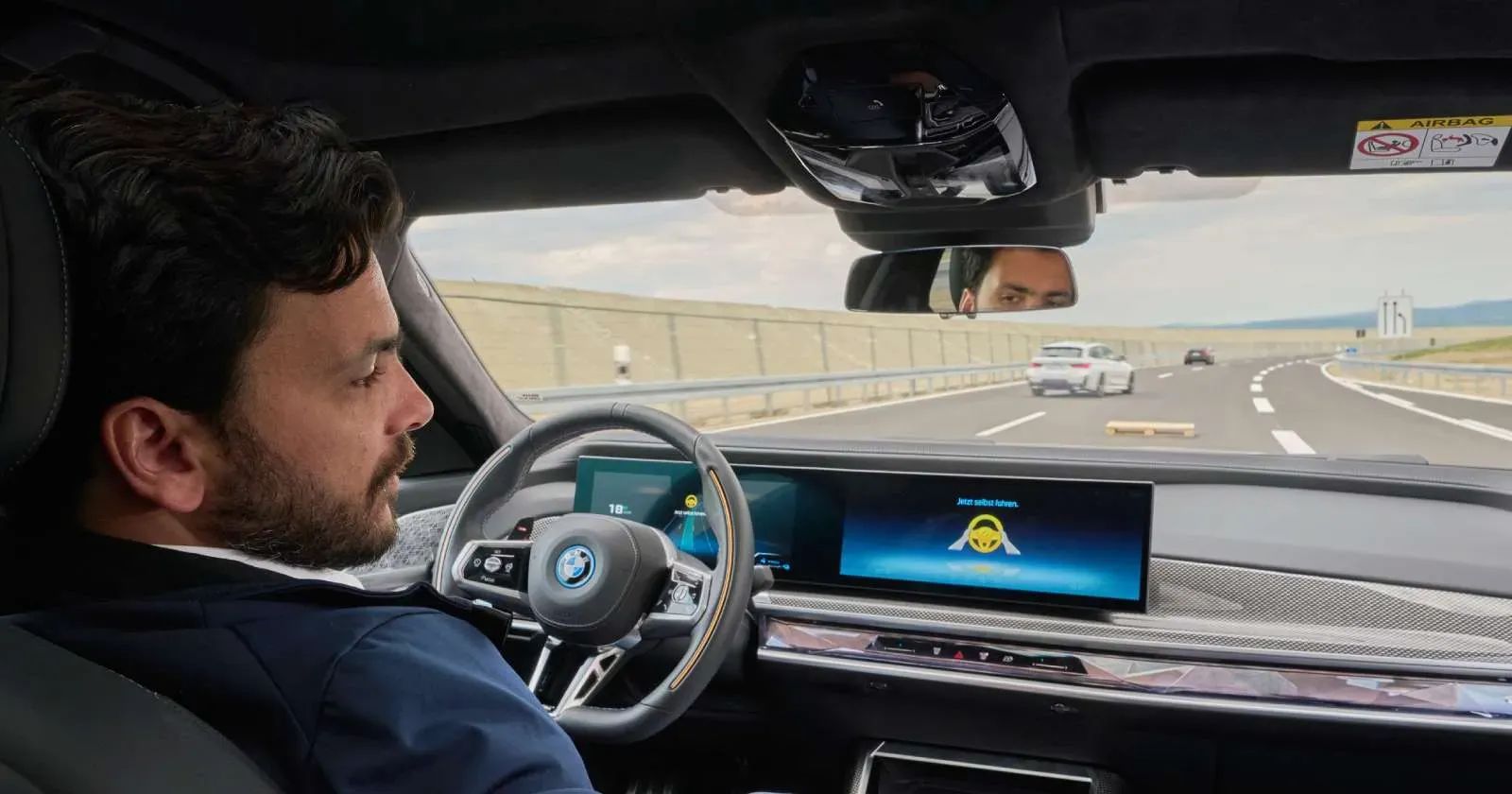
A car displays an alert asking the driver to return their hands to the wheel. (Image credit: BMW)

Share Post

A car displays an alert asking the driver to return their hands to the wheel. (Image credit: BMW)
All new passenger cars registered within the European Union as of July 7 this year must have an infrared camera and eye tracking system to monitor the driver for signs of distraction and drowsiness, according to changes to the EU’s General Safety Regulation that have come into effect. Advanced emergency braking with pedestrian and cyclist protection is also now mandatory. The regulations also call for stricter norms for tyre wear testing, safety glass, and forward visibility.
The rules were structured to come into effect gradually, giving manufacturers time to comply. All newly launched models have been required to have such safety equipment since 2024, and now the rules have expanded to include all units sold regardless of when a model was first launched. The EU’s long-term goal, called Vision Zero, is to eliminate all road transport fatalities by 2050.
According to the EU’s documentation, “Advanced emergency braking systems, intelligent speed assistance, emergency lane‐keeping systems, driver drowsiness and attention warning, advanced driver distraction warning and reversing detection are safety systems that have a high potential to reduce casualty numbers considerably.”
Regulators are also preparing for a future with autonomous cars, saying such technology will come into play, especially with systems that require the human to be paying attention and ready to take over control.
The new 2026 Euro NCAP protocol requires cars to be outfitted with driver distraction prevention systems. The first model to be tested under this regimen, the BMW iX3, has been awarded five stars. It is capable of detecting driver impairment or distraction, as well as occupant presence and stature in order to calibrate airbag deployment.
Driver monitoring systems in the EU are required to sound an alert, display a warning, or use vibration to urge a driver to return their attention to the road if they look away. The threshold is six seconds when driving at speeds between 20 and 50 kmph, or 3.5 seconds at speeds above that.
Interestingly, the regulations specify that all camera-based safety features should work without sending any data to the car’s manufacturer or any authority, ie a “closed-loop” system running locally. Footage must be recorded over, and no data may be retained indefinitely. Systems should also not need biometric information, which means face recognition and user tracking.
Critics and users on social media have also pointed out the propensity of such systems to issue false alarms, such as when drivers blink or glance away momentarily. Constant unnecessary alerts could actually be more distracting for drivers.
It is also not clear what other kinds of data a car might collect about its drivers’ behaviour, and how that might be used or sold. While several key privacy concerns are addressed, manufacturers do not seem to be restricted from implementing facial recognition for other capabilities, such as Tesla’s reported upcoming FSD activation checks.
The USA is set to introduce similar requirements for automakers in 2027.
Ather to Unveil Affordable EL Platform Electric Scooter On August 29
Arun Mohan Nadar 14 Jul, 2026, 2:47 PM IST
Triumph Speed Twin 1200 TFC Breaks Cover
Arun Mohan Nadar 14 Jul, 2026, 1:40 PM IST
Kia Carens Crosses 3 Lakh Sales Milestone in India
Acko Drive Team 14 Jul, 2026, 12:55 PM IST
Driver Monitoring Cameras Now Mandatory for Cars Sold in EU: Critics Highlight Data Privacy Concerns, False Alarms
Jamshed Avari 14 Jul, 2026, 12:24 PM IST
HPCL Completes Nationwide Fuel Quality Checks
Acko Drive Team 14 Jul, 2026, 10:47 AM IST
Looking for a new car?
We promise the best car deals and earliest delivery!