
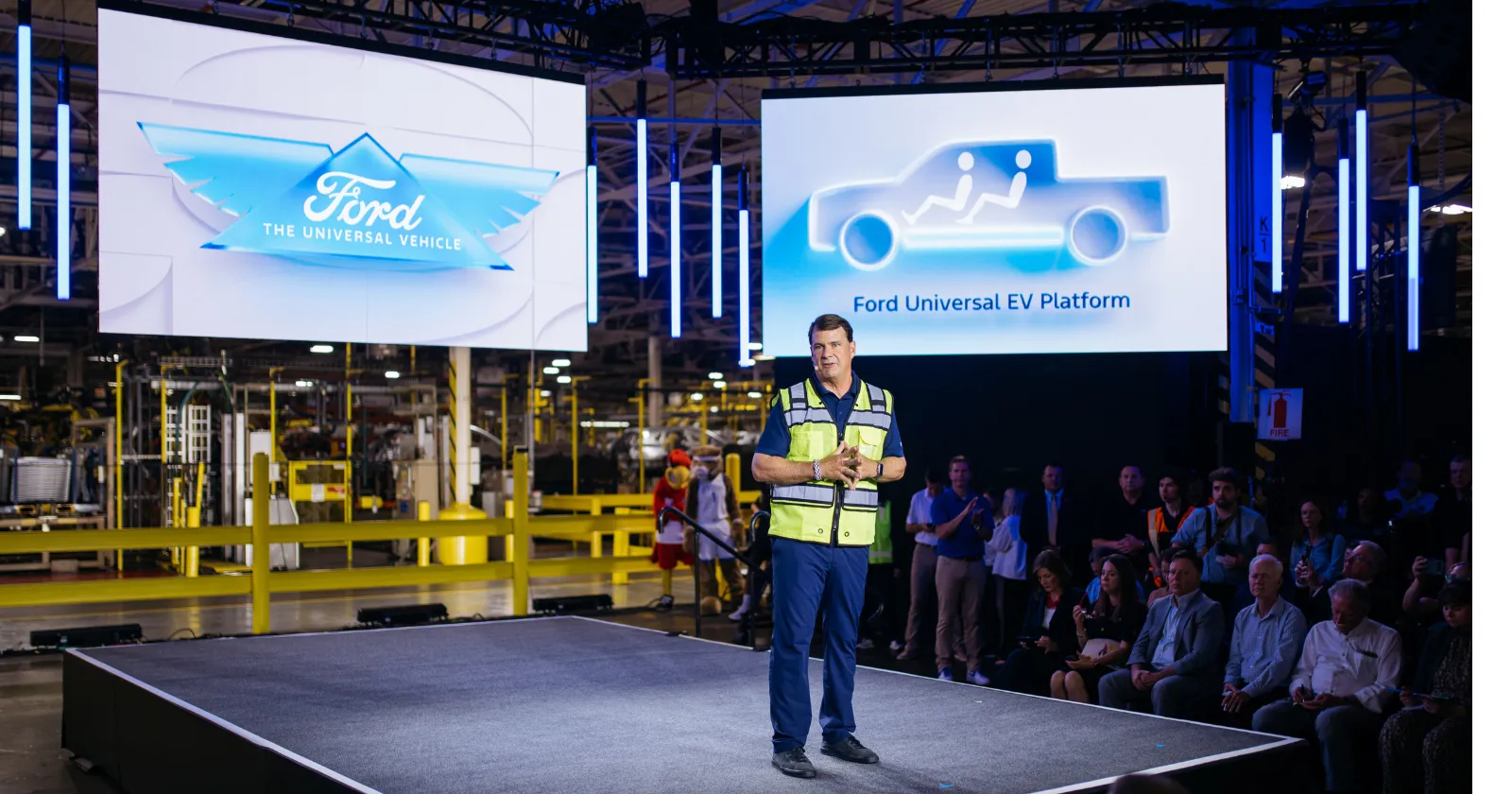
Ford President and CEO Jim Farley talking about how the company will revolutionise the EV space
Backed by a $5 billion US investment, the platform will debut in 2027 with a midsize four-door electric pickup starting at about $30,000.


Share Post
Ford President and CEO Jim Farley talking about how the company will revolutionise the EV space
Backed by a $5 billion US investment, the platform will debut in 2027 with a midsize four-door electric pickup starting at about $30,000.

Ford Motor Company has pulled the wraps off its “Universal EV Platform” — a cost-cutting, highly adaptable electric vehicle architecture that could redefine affordable EV mobility worldwide. Backed by a $5 billion US investment, the platform will debut in 2027 with a midsize four-door electric pickup starting at about $30,000.
This marks a strategic shift from Ford’s earlier EV programs. Models like the Mach-E and F-150 Lightning relied on dedicated but expensive platforms or ICE-derived chassis, limiting affordability. The new Universal EV Platform, by contrast, is engineered for global scalability, cutting vehicle parts by 20%, fasteners by 25%, and assembly time by 15%, thanks to a zonal electrical architecture and prismatic lithium iron phosphate (LFP) batteries.
Ford says the LFP battery pack — cobalt- and nickel-free — slashes raw material costs by up to 30% and doubles as the vehicle’s structural floor, freeing space and improving handling. The first product will be assembled at Ford’s Louisville Assembly Plant in the US, but its flexible design could be adapted for multiple body styles, including compact SUVs and utility pickups suited for India.
“Affordability is the breakthrough here,” said Ford CEO Jim Farley. “We’ve created something fun to drive, efficient to build, and sustainable to scale.”
For India, where the average passenger car sells for under ₹12 lakh (~$14,000) and EV penetration is under 2%, such flexibility could be decisive. Yet, tariff barriers remain a hurdle — fully built imported EVs from the US currently attract 70–100% duties. Ford could navigate this via CKD (completely knocked-down) kits assembled locally, bringing tariffs down to 15–30% under current rules.
With global EV demand forecast to grow from 14 million units in 2023 to 40 million by 2030 (IEA), the Universal EV Platform could position Ford to compete in both mature and price-sensitive markets — if it localizes production effectively.
Feature | Earlier Platforms (Mach-E, F-150 Lightning) | Universal EV Platform (2027 onward) |
|---|---|---|
Base Design | Dedicated EV or ICE-adapted chassis | Single scalable platform across multiple body styles |
Cost Focus | Higher manufacturing cost, premium pricing | Cost-optimized: 20% fewer parts, 25% fewer fasteners |
Battery Tech | NMC lithium-ion (cobalt, nickel content) | Prismatic LFP (cobalt- & nickel-free, structural) |
Assembly Process | Traditional moving line | “Assembly tree” with parallel sub-assemblies |
Market Target | US & Europe premium EV buyers | Global reach, including price-sensitive markets |
India Potential | Limited due to cost | High, if localized via CKD/SKD kits |
Tariff Challenge | 70–100% on CBU imports | 15–30% possible with local assembly |

One Crore FASTag Annual Passes Issued in Just Over One Year
Jamshed Avari 28 Sept, 2026, 2:51 PM IST
Global Automotive Research Centre Gets ₹221 Cr PM E-Drive Grant to Upgrade Testing Facilities
Jamshed Avari 28 Sept, 2026, 2:07 PM IST
SWITCH Mobility Secures Order for 840 Electric Buses for Delhi Public Transit Fleet
Acko Drive Team 28 Sept, 2026, 10:42 AM IST
Oben Electric Rolls Out 10,000th Rorr Motorcycle From Bengaluru Plant
Krishna SinhaChaudhury 28 Sept, 2026, 10:15 AM IST
Maruti Suzuki Targets 4 Million Unit Annual Production Capacity in India by FY 2030
Acko Drive Team 28 Sept, 2026, 9:15 AM IST

Looking for a new car?
We promise the best car deals and earliest delivery!
