
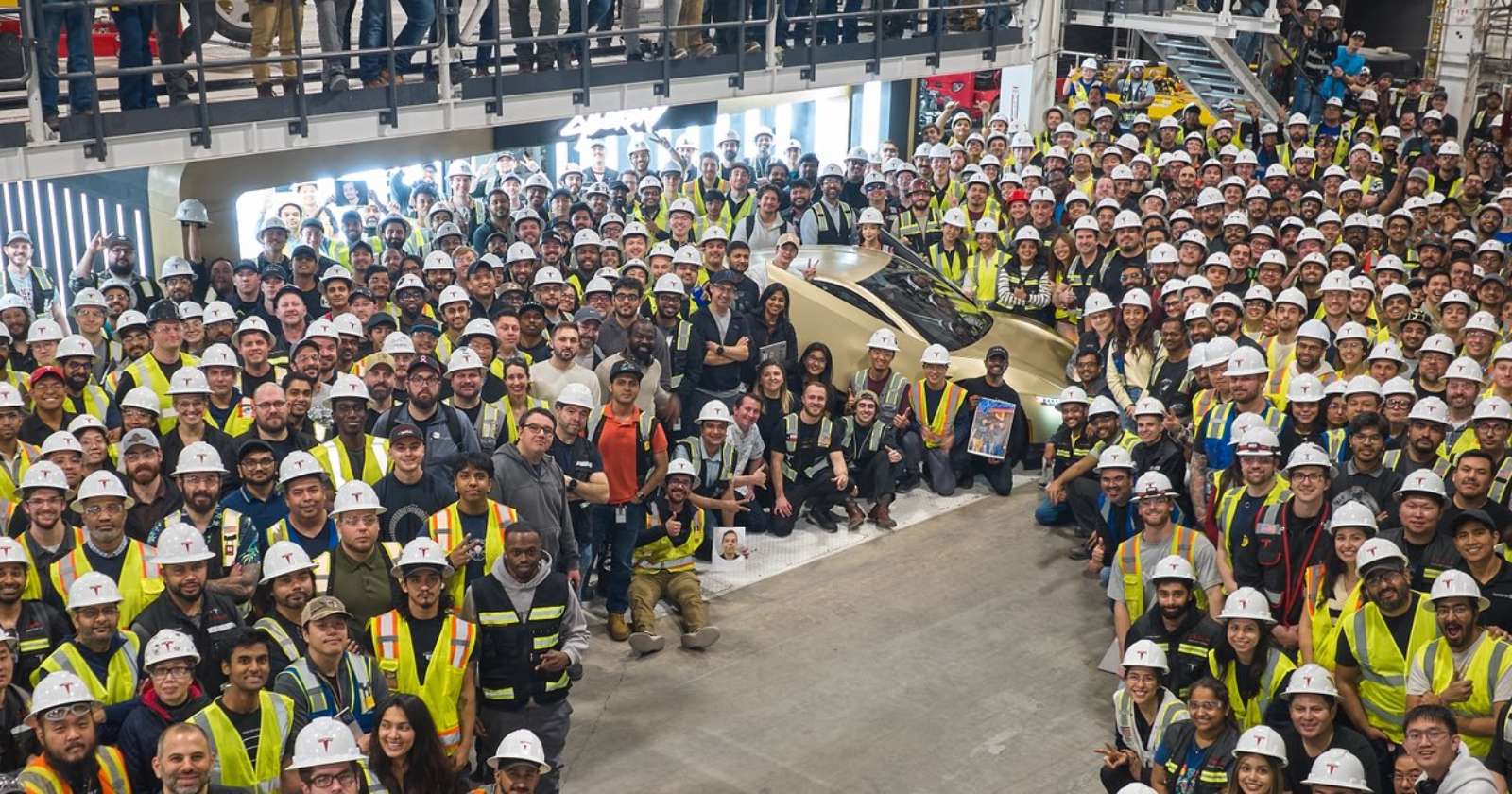
Giga Texas staff posing with the first production Cybercab.



Share Post
Giga Texas staff posing with the first production Cybercab.
Tesla has announced that the first Cybercab has rolled off the line at its Giga Texas manufacturing facility, ahead of a planned April 2026 mass production target. The two-seater has no steering wheel or pedals, and is designed to operate completely autonomously.
The model, first shown off at a Tesla event in October 2024, is meant to be a taxi that can be hailed via an app as part of the company’s current Robotaxi network which is operational only in a limited area of Austin, Texas, with a safety officer in the front passenger seat. In San Francisco, Robotaxis may operate but with a human in the driver’s seat. It is not yet clear where the Cybercab will be allowed to operate, as there is no scope for a human operator sitting in the vehicle to take over if needed.
Tesla’s current autonomous Robotaxi operations have been plagued with reports of accidents and unsafe driving behaviour. Plans to expand to other cities and countries have not yet materialised. The company has also faced lawsuits and regulatory challenges for the marketing and use of its “Autopilot” and “Full Self Driving” features, and is no longer allowed to use the former name in California.
Company CEO Elon Musk announced the two-seater Cybercab would be prioritised over previous plans to introduce a low-cost Tesla model. In terms of specifications, it features a 35kWh battery and has a claimed range of 320 km per charge. Wireless charging was one of Tesla’s initial promises, but charging time is still not known. The cabin features a 20.5-inch central infotainment touchscreen. Tesla has used the same AI4 processor for self driving that the rest of its current lineup has, rather than the now-delayed AI5 which promises superior performance.
Scissor doors that open upwards are said to make ingress and egress comfortable. Interestingly, the prototype shown in 2024 had no external door handles; a design that is likely to fall afoul of regulators in light of recent safety regulations in parts of the world. There are also no mirrors and no rear window. Regulations might also require drivers' controls, as evidenced by sightings of at least one modified test unit.
Tesla has also used the Cybercab to trial a new “unboxed” manufacturing process which allows for multiple parts of the vehicle to be assembled simultaneously and then put together, rather than a sequential process as the chassis moves across an assembly line. While initial production is expected to be "agonisingly slow", Musk has previously stated that millions of units can be produced per year, with one being completed every 10 seconds.
Musk has also reiterated via social media that Tesla plans to sell the Cybercab to retail buyers for under $30,000 (approximately ₹27,19,260) by 2027.

Kia Sorento vs Škoda Kodiaq vs VW Tayron vs Jeep Meridian: Spec Comparison
Tushaar Singh Gill 4 Sept, 2026, 12:38 PM IST
ReiseMoto Launches MT Thunder 4 SV Helmet in India at ₹13,699
Acko Drive Team 4 Sept, 2026, 11:49 AM IST
Kia Syros Flex Fuel to Launch When Market is Ready: Company Shows Off Concept Model
Jamshed Avari 4 Sept, 2026, 11:22 AM IST
Royal Enfield Himalayan 440 Launched at ₹2.29 Lakh
Tushaar Singh Gill 4 Sept, 2026, 10:15 AM IST
Kia Carnival HEV Launching in India Soon as Part of Kia’s Powertrain Diversification Strategy
Jamshed Avari 4 Sept, 2026, 9:00 AM IST

Looking for a new car?
We promise the best car deals and earliest delivery!
