

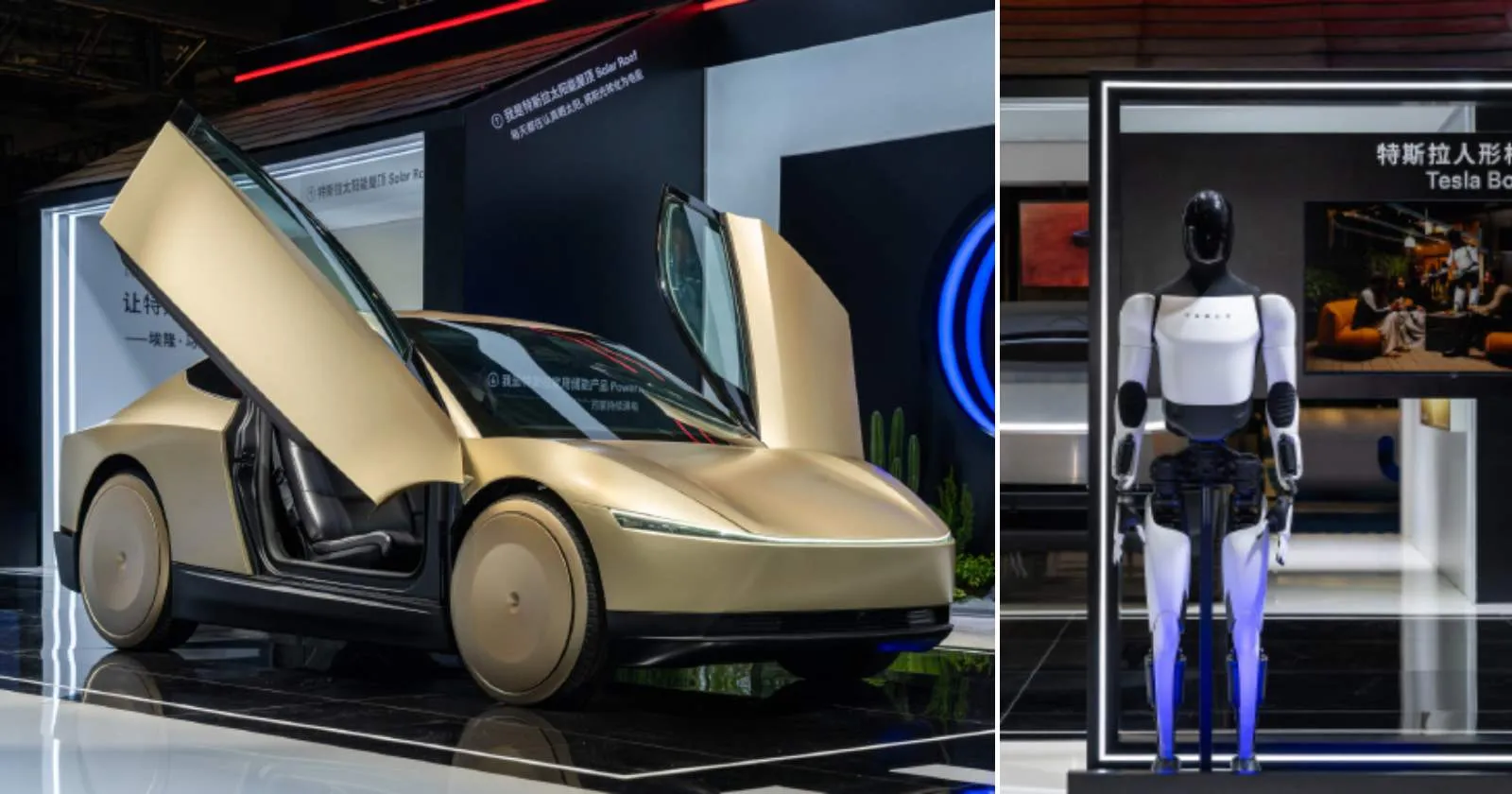
Tesla China brought a pre-production Cybercab to its booth at the annual China International Import Expo (CIIE) event in Shanghai, which began on November 5. The controversial car, which has not been launched yet in the US, is a cornerstone of Tesla and Elon Musk’s ambition to set up a massive network of autonomous taxis. The exhibit indicates that the Cybercab could be launched in China following its US debut, expected in the middle of next year.
A prototype was unveiled late last year at an event in California, and test units have reportedly been spotted around the company’s Giga Texas manufacturing facility where it will enter mass production. Musk has publicly committed to a Q2 2026 window for production to begin.
The cybercab has so far drawn criticism for its design and positioning. With only two seats, it could be useful for urban commutes, but less so for families. It has been designed for public transportation from ground up. Most notably, it has no steering wheel, pedals, or even mirrors – although recent statements by company officials suggest that it might have to be fitted with driver’s controls to comply with current regulations.
Tesla currently operates its Robotaxi network of self-driving Model Y cars in a limited area within Austin, Texas, with plans to expand to other cities. The Cybercab will eventually join in, giving users a choice of different cars for different needs, which can be ordered per ride via an app. Musk has in the past spoken about how Tesla owners will one day be able to allow their cars to serve as self-driving taxis when not in use, earning extra income for their owners.
Prior to the Cybercab, Tesla was working on a sub-$30,000 car, positioned below the Model 3, which was widely seen as key to the company’s next phase of growth especially in markets such as India, which it was trying to enter at the time. However, that project was cancelled in favour of the Cybercab. Tesla recently launched its lower-priced Model 3 Standard and Model Y Standard instead.
Tesla is bullish on China, with initiatives to combat homegrown EV giants, including the China-exclusive six-seater Model Y L and extended-range Model 3. The company is also betting on its Optimus humanoid robots, which are also on display at the ongoing CIIE event. While China could be on Tesla’s radar for a large-scale Robotaxi rollout, it is unlikely that India will follow soon, as even the company’s Full Self Driving feature which costs ₹6 lakhs but is not yet available here. FSD also continues to attract criticism, including legal challenges and government safety audits in markets where it has rolled out.