What is ABS?
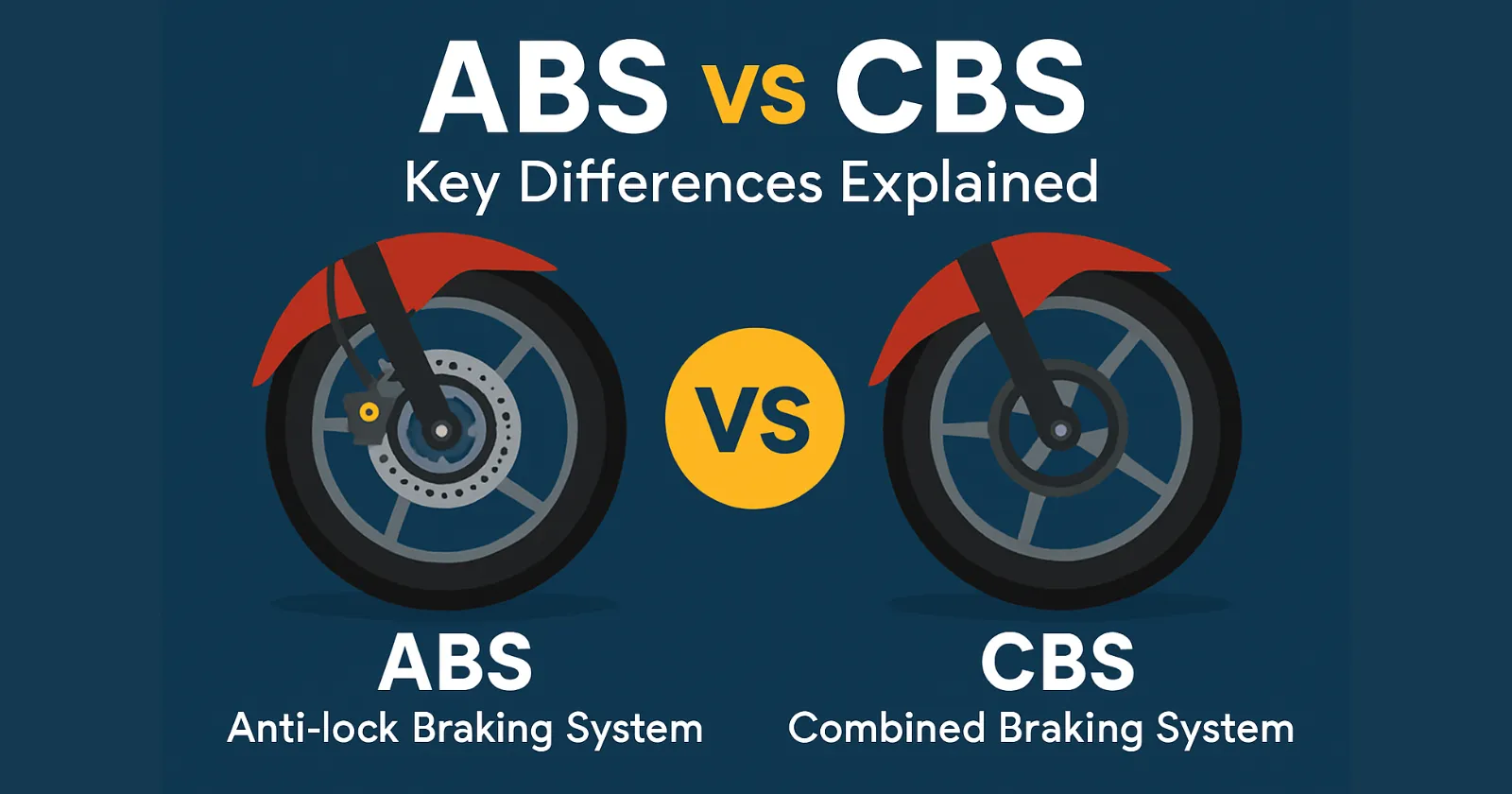
ABS, or Anti-lock Braking System, is a safety feature in two-wheelers that helps prevent the wheels from locking up during sudden or hard braking.
When you hit the brakes hard, especially on wet or slippery roads, there’s a chance your wheels can stop rotating while the bike is still moving. This is called a wheel lock, and it can cause your bike to skid or even fall.
ABS uses sensors on the wheels to detect if they are locking up. When the system senses this, it quickly reduces and re-applies brake pressure, automatically and within milliseconds. This helps your bike slow down safely while still keeping grip on the road, allowing you to maintain control and steer.
Benefits of ABS:
- Prevents skidding on wet or loose roads
- Improves safety during emergency braking
- Helps maintain control while braking
- Reduces stopping distance in many cases
In India, ABS is mandatory for bikes with an engine capacity of 125cc and above.
What is CBS?
CBS, or Combined Braking System, is a braking technology that applies braking force to both wheels, even if you press only one brake lever.
For example, if your scooter has CBS and you press just the rear brake lever, the system will automatically apply some force to the front brake as well. This balances the braking and gives you better control and smoother stops, especially useful for beginners or city riding.
CBS is commonly found on scooters and entry-level motorcycles, especially those with less than 125cc engine capacity.
Benefits of CBS:
- Applies brake force on both wheels
- Offers smoother and more balanced braking
- Reduces the chances of skidding due to brake misuse
- Simple and affordable safety system
Difference Between ABS and CBS
ABS prevents the wheels from locking up when you brake suddenly, which helps you stay in control of the bike, especially on slippery or uneven roads. On the other hand, CBS applies brake force to both wheels even if you press just one brake; this helps balance the bike better and makes stopping easier, especially for new riders.
While ABS is more advanced and offers better control during emergency braking, CBS is simpler and usually found in smaller bikes and scooters.
Here’s a table to help you understand how ABS and CBS are different.
| Feature | ABS (Anti-lock Braking System) | CBS (Combined Braking System) |
| Full Form | Anti-lock Braking System | Combined Braking System |
| How it works | Uses sensors and electronics to prevent wheel lock-up | Distributes brake force to both wheels |
| Wheel Lock Prevention | Yes, prevents wheel lock during hard braking | No, it may still lock if overused |
| Technology Type | Electronic + Hydraulic | Mechanical or Hydraulic |
| Common in | Bikes above 125cc (mandatory in India) | Scooters and bikes below 125cc |
| Best for | High-speed, highway, and emergency braking | Daily city riding and beginner safety |
| Cost | More expensive | More affordable |
| Control in Slippery Conditions | Excellent control and safety | Better than no system, but not as effective as ABS |
| Steering Control During Braking | Maintains control | Partial control, depends on road condition |
CBS attains stability by automatically splitting braking pressure, which benefits neophytes or regular urban riders. It won't, however, prevent wheel lockup when braking too severely, especially on slippery terrain. ABS, however, prevents the wheels from locking up and enables braking even on wet roads, gravel, or sudden braking.
ABS has the capability of reducing motorcycle fatality crashes by approximately 20 per cent, and CBS can provide approximately 10 per cent of risk reduction. Also, stops with ABS can also take 25 per cent less time under normal conditions.
Laws and Regulations in India
Braking has been governed depending on the engine capacity.
- All of those two-wheelers that are below 125cc should be equipped with CBS or single-channel ABS under recent legislation, and motorcycles above 125cc need to have double-channel ABS.
- From 2026 onwards, however, all brand-new two-wheelers, no matter what the capacity of the engine is, will need to be equipped with ABS.
This is part of an overall measure for road safety enhancement as well as for checking deaths due to braking mistakes.
How Each System Impacts Riding Style
CBS is suitable for neophytes or less experienced riders. It minimises the learning process because CBS makes up for improper braking use of the type where you ride the back too hard and forget the front.
But as your confidence grows and you ride faster or under different conditions, you'll likely benefit more from ABS. As you can brake hard without locked-up tires, you get more confidence and control.
Factors to Consider for Daily Commutes and Long Rides
- If most of your rides are short city rides on fairly good streets, CBS offers safety without excessive complexity. It has good support for smoother braking for stops and low-speed braking.
- If you frequently use highways, travel through hilly terrain, or travel during monsoons, ABS becomes more beneficial.
- ABS is also very handy for longer rides where reaction time is likely to slow down due to fatigue. You will have a sense of security as you know that your brakes will react correctly, whether you are on high-speed or riding on a slippery road.
Maintenance and Service Requirements
CBS is simple and needs minimal servicing. Occasional checking of fluids and brakes should suffice to keep the system working efficiently. As there are no electronic controls or sensors, servicing is also simple and less expensive as a whole.
ABS, being advanced, is also very reliable. Periodic interchange of brake fluids, maintenance of the sensor, and checking of the system during planned servicing are usually adequate to maintain performance. As nothing is complex, frequent maintenance is not required. Riders simply have to take care that the change of wheel or tyre is done systematically so that the sensor remains aligned and functional.
Choosing What’s Best for You
It is your call based on where, how, and how frequently you ride. It is your option to use CBS as a basic maintenance method for your safety if you're a new rider or ride only for short distances. It provides basic stability and braking response for the motorcycle during daily rides.
That being said, if you ride in heavy traffic areas or longer distances, ABS is a better option. It is an upgraded safety component, and where most needed, it makes that difference.
In the long run, ABS does more than improve the braking system; it provides confidence between the machine and the rider and makes for an easier, more confident ride down the road.
Final Thoughts
Braking systems have advanced significantly over the last two decades, and deciding between ABS or CBS is not technical, but it’s more about your safety and confidence out on the road. In Indian riding conditions, where sudden braking and hidden road hazards are a day-to-day phenomenon, ABS is the ultimate solution.
While CBS is better than conventional brakes but most suitable for its purpose of use, ABS is best for accident prevention and safer rider management. In crux, the use of ABS is mandatory for all two-wheelers.
Frequently Asked Questions