Triumph has mastered the art of building modern classic motorcycles with the Bonneville range. The T120 and the T100 are fantastic motorcycles, holding on to the past while staying in the present with their technology. And it is bringing that same technology and philosophy to the new Bonneville T40, its most accessible Bonnie ever. And it promises not just a shrunken version of the T100, but more technology, advanced rider aids and a whole lot more. So, the question isn’t whether this is a good motorcycle or not, but whether it can evoke the same feeling as the original once did.
In this article
Triumph Bonneville T40 Review: The Legend Of Bonneville
The Bonneville range stands for a legacy of British heritage, timeless design and high performance since 1956. The fine handling with a powerful, lightweight chassis, and the beautiful lines inspired a generation of riders, and even cafe racers over the years. With the new Bonneville T40, Triumph is not only attempting to build a Bonnie for the masses, but also appeal to a newer generation of tech-first customers without losing the real character.
Triumph Bonneville T40 Review: Design
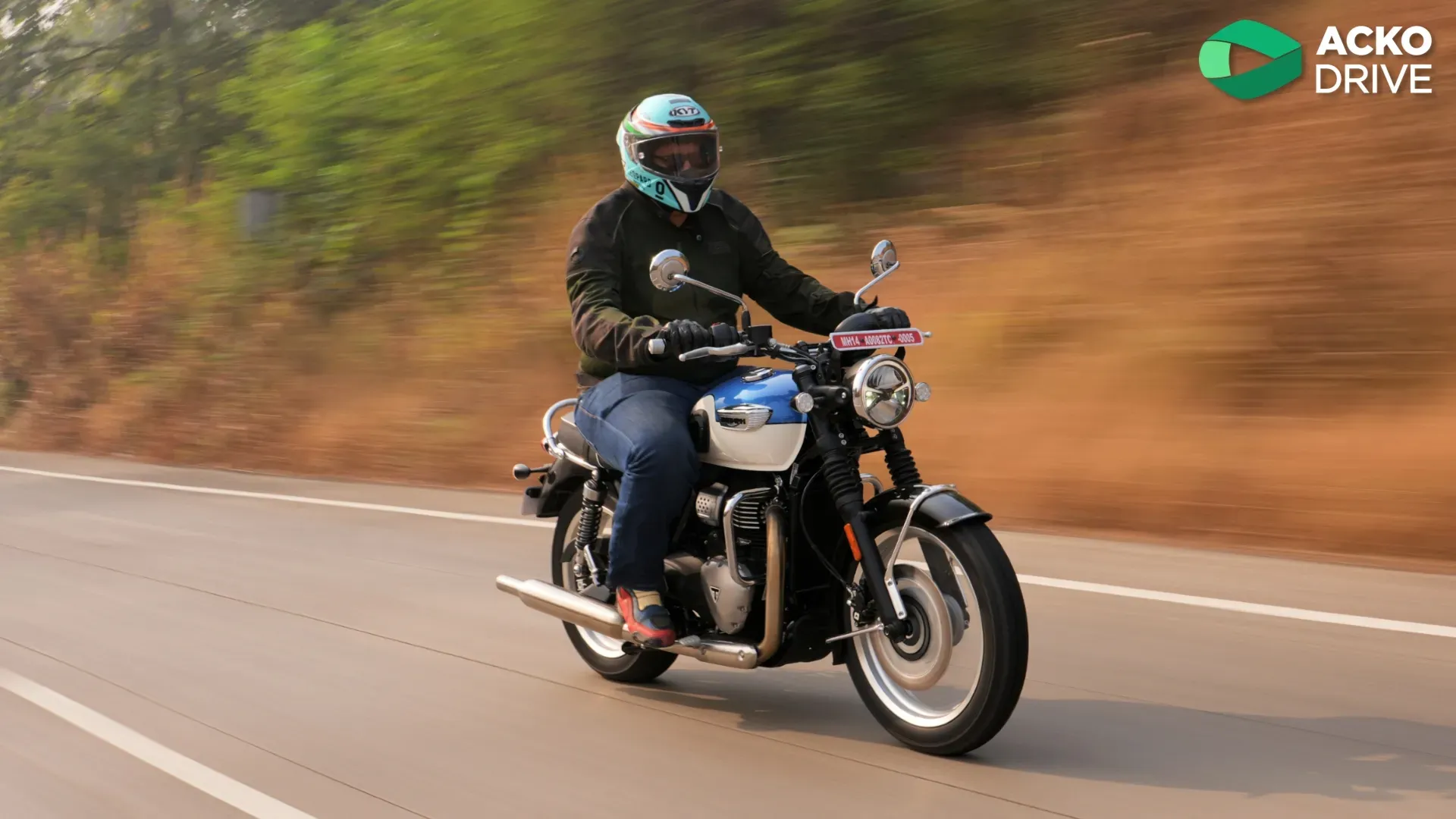
Triumph has fabulously replicated the design from the bigger Bonnevilles. You will have to do a double-take to realise this is not the bigger Bonneville T100 but a smaller single-cylinder motorcycle instead. The heritage design elements are instantly recognisable - the classic round headlamp, teardrop-shaped fuel tank, and longer mudguards, all of which give the Bonnie T40 its classic silhouette. The stance is incredibly well-balanced, and the lines simply flow into each other. The bike rides on an 18-inch front and a 17-inch rear aluminium finish spoke wheels, which do look period correct but are not tubeless.
Triumph Bonneville T40 Review: Fit & Finish
Underneath the metal work is a nearly new frame on the Bonneville T40. The front half remains largely identical to the Speed 400, the rear subframe is all-new. This, Triumph says, is close to keeping the stance authentic to the bigger Bonnies. It also helps accommodate the steel swingarm and twin shock absorbers. Do note, the rear subframe has been welded to the main frame, unlike the Speed 400 which gets a bolt-on subframe. The new setup also opens room for Triumph if it wants to bring more nameplates including the Speedmaster and Bobber in the single-cylinder format.
The detailing further makes this a stunning motorcycle. Be it the handpainted coach lining on the fuel tank, throttle body cover, silver finished levers, or even the finish on the engine casing, everything feels special. The T40 gets the dual paint scheme along with an all-black option. On the other hand, the Bonneville T4 gets monotone colours without the chrome Triumph badge on the fuel tank. Triumph has also revised the engine placement, making it more upright, to keep it true to the original position, while also allowing better weight distribution.
If you thought the Speed 400 was puny, this is a lot more substantial. The road presence is fantastic, and the fit and finish are excellent. Triumph has really outdone itself. The paint quality, the chrome on the fuel tank and the grab rail, and, in fact, the stainless steel finish on the peashooter exhaust — everything feels like it’s from a segment above. And I have to say, it’s a very well-built, very well-put-together motorcycle that’ll keep you happy and get you all the attention.

Triumph Bonneville T40 Review: Instrument Console
Perhaps, the most advanced element on the Bonneville T40 is the instrument console. The traditional twin-pod analogue cluster is replaced by a round 4-inch TFT screen. It gets crisp graphics and Bluetooth connectivity with call and SMS alerts. There’s navigation via the mobile app, which works well too. Triumph also has a ‘Heritage mode’, which makes the digital dial go all-retro in appearance. The TFT screen, however, is restricted to the more expensive T40 variant, while the entry T4 variant gets a round LCD screen instead. Notably, the T4 remains specific to the Indian market. Other features include a USB charging port, hazard lights, LED headlamp with auto dip, LED indicators, and more.
Triumph Bonneville T40 Review: Engine & Performance
This is the 349 cc TRC series engine. India gets the smaller engine compared to the global
markets, which still use a 398 cc engine, like the other 400s in the segment. But what you get here is a very differently tuned engine compared to the other Speed, the Tracker or even the Scrambler from the Triumph family. There are changes to the engine itself. There’s a new camshaft, the airbox is different, and even the intake ducts are different compared to the Speed 400. The overall idea here is a different tuning and a different flavour altogether. The character needs to be a little more old-school, a little more relaxed, and that’s what you see
here. This one makes about 31.2 Nm and about 28.5 bhp, paired with a six-speed gearbox.
What I really love is just how tractable this engine is. It’s really nice. It starts off with a nice
rumble, not a thump, but a nice bassy rumble.
This is very seamless to ride, and not intimidating. There is a clear concentration of power in the low and mid-range versus the top end. You can go around the city, puttering at about 35 kmph in fifth gear, very easily with the impressive mid-range. It allows you to sit at 120 kmph in fifth gear comfortably, and that’s where the big difference will be compared to the competition. This can do high speeds without any vibrations. There is very little buzziness at around 6,000 rpm, but that’s about it. There is very little to complain about in terms of the overall performance.
The 6-speed gearbox offers slick shifts. Triumph has reworked the transmission to have taller gear ratios in the final drive for a more relaxed riding feel. Out on the road, it’s a reasonably quick motorcycle, and has just the right kind of heft to feel old-school. The wide 150-section rear tyre not only brings more visual appeal but also ensures you have enough traction when you want to go fast in a straight line.
Triumph Bonneville T40 Review: Ride Modes & Cruise Control
There are 5 riding modes on the bike. Eco and Rain dull acceleration marginally, while the Road mode feels more enthusiastic. The custom modes allow you to tinker around with the ABS and traction control settings, as per your preference. Triumph also offers cruise control on the T40. It’s simply effortless and easy to engage and disengage on the road.
Triumph Bonneville T40 Review: Ergonomics
The riding posture is super accessible on the baby Bonnie. I’m 6’2” and with a seat height of 795, it’s super easy to flat foot on the motorcycle. The centre-set position on the footpeg further makes it comfortable over long rides, and the handlebar is nice and wide, and offers an upright riding position. The seat cushioning is good enough, not too soft, so spending long hours on the saddle shouldn’t be taxing. The seat is long enough to accommodate the pillion as well, while there are several mounting points for your luggage.
The Bonneville T40 is a heavy motorcycle at 195 kilos, In fact, it’s the heaviest of all the Triumph 400s, and yet, it’s super easy to put it on the main stand. The weight is spread out and is manageable when the bike is at a stand still.
Triumph Bonneville T40 Review: Ride Quality, Handling & Braking
Despite that kerb weight, much of it vanishes when you are on the saddle. The Bonneville T40 is incredibly well-balanced and quite easy to manoeuvre in tight situations. Handling is quite on point too, and the bike is predictable around a corner. The telescopic forks up front and the twin shocks at the rear come with 130 mm of travel on either side. The suspension setup is slightly on the firmer side but comfortable enough over most surfaces. A nasty pothole or speed breaker will throw you off, but by and large, it’s just what you need on a variety of terrains. High-speed stability is excellent on the Bonnie.
The braking performance on the motorcycle leaves a lot to be desired. The bike gets disc brakes at either end with dual-channel ABS as standard. The T40 variant adds a 6-axis IMU with cornering ABS and traction control. Braking is progressive but lacks the necessary feel on the lever. A sharper bite would be more confidence inspiring, especially since the motorcycle loves to go fast.
Triumph Bonneville T40 Review: Verdict
Does the Bonneville T40 evoke the same feeling as the bigger Bonnies? The answer is yes. It’s a gorgeous-looking motorcycle. The stance, proportions, fit and finish - everything feels like a true Bonnie. And the riding experience is great as well. The TR series engine is fantastic and very well tuned. There's a strong grunt at the low end, and that exhaust sound nice and meaty. The ride quality is nice, it’s very predictable around a corner, and everything feels very well put together. But then, what’s the caveat? The prices are on the premium side. The Bonneville T4 starts at ₹2.55 lakh, and the T40 is priced at ₹2.80 lakh (ex-showroom). There is a clear premium positioning compared to its biggest rival, the Royal Enfield Classic 350. So, which of these would make for the better modern classic? That’s the question we ask, and we will answer it very, very soon. There is a modern classic showdown coming your way.