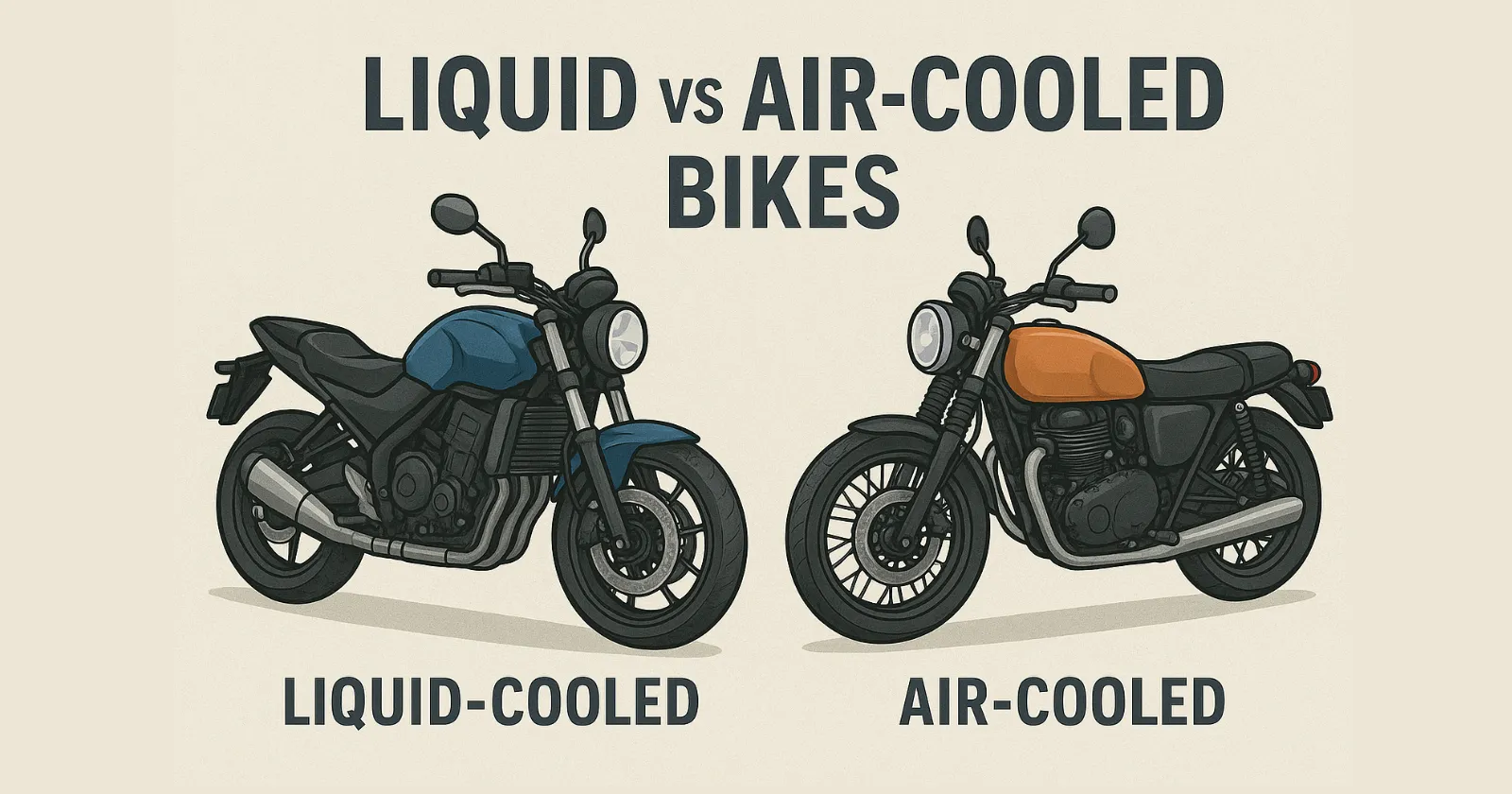
What is an Air-Cooled Bike?
An air-cooled engine is designed to dissipate unwanted heat by exposing the engine surface to the air directly. The engine has fins, or long metal ridges, on the cylinder and head. The fins provide a much greater surface area for the engine, enabling it to dissipate heat more effectively into the air as you continue travelling. The faster, the more air rushes over the fins, assisting in cooling.
There is no fan, radiator, or coolant to work with the system relies completely on natural ventilation. There are a few bikes that possess a fan blowing air across the fins when the bike is stationary, but it's not typical in basic air-cooled systems.
Practical Applications
Air-cooling is utilised in low-displacement commuter bikes, retro cruisers, and budget bikes, where easy engine maintenance and low maintenance are desired. These engines are suitable for riders who travel a short distance within the area or ride at moderate speeds.
Indian Examples
- Hero Splendor Plus: India's most popular commuter bike with a reliable air-cooled 97.2cc engine. Known for being frugal and offering a low cost of ownership.
- Bajaj Platina 110: Another commuter legend, with the tried and tested air-cooled engine tuned for economy and comfort.
- Royal Enfield Bullet 350 (Pre-J Platform): Sold on its vintage look, the pre-J models of the Bullet utilised a clean air-cooled engine, famous for its thump character.
What is a Liquid-Cooled Bike?
Liquid cooling, the title sort of gives it away, uses a liquid coolant to extract heat from the engine and relay it and here's how it works:
- A mix of water and antifreeze (a coolant blend) is pumped through specially designed channels around the hottest parts of the engine.
- This hot fluid is driven to a radiator, where it's sent through an array of thin tubes and fins.
- When air is blown across the radiator (by motion or with the assistance of a cooling fan), the coolant is cooled.
- The cooled fluid is thereby cycled back to the engine, with a steady and constant operating temperature.
- Such a system allows accurate thermal control, keeping engines at their optimal level for extended durations and under heavy stress.
Use Cases
Liquid-cooled engines are used on performance motorcycles, sport bikes, touring motorcycles, and large-capacity cruisers. They are for motorcyclists who require power at all times, smooth throttle response, and improved fuel economy under diverse conditions.
Indian Examples
- KTM RC 200: 199.5cc liquid-cooled single-cylinder motorcycle that is renowned for razor-sharp handling and aggressive power delivery.
- Yamaha R15 V4: Streamlined faired 155cc sportbike with liquid-cooled engine, offering peerless performance in the class.
- TVS Apache RR 310: Co-developed with BMW, the liquid-cooled sport-tourer of 312cc combines power, refinement and practicality.
- Honda CB500X (Imported): Adventure tourer of mid-capacity with liquid-cooled parallel twin, perfect for touring far and wide.
Air-Cooled vs Liquid-Cooled Bikes: Key Differences
Parameter | Air-Cooled Bikes | Liquid-Cooled Bikes |
| Cooling Method | Uses air and engine fins | Uses coolant, radiator, and fan |
| Complexity | Simple mechanical design | More components, a complex system |
| Maintenance | Low maintenance | Requires periodic coolant and inspection |
| Weight | Lightweight | Heavier due to added parts |
| Performance Under Stress | Can overheat in traffic or on long rides | Stable performance across conditions |
| Noise and Emissions | Louder, higher emissions | Quieter, more environmentally friendly |
| Best Suited For | City commuting, short distances | Long rides, high-speed and sporty use |
Advantages and Disadvantages
✅ Air-Cooled Bikes:
Pros
- Economic: Low upfront and servicing costs.
- Lightweight: No coolant system reduces total weight, improves handling and fuel efficiency.
- Mechanically Simple: Less complicated for do-it-yourself repair and best for rural conditions with low servicing.
- Fewer Points of Failure: No coolant leaks, fan faults, or radiator failure to contend with.
Cons
- Traffic Overheating: Stationary for long periods reduces cooling effectiveness.
- Dip in Performance at High Temperatures: The Engine loses power or fuel efficiency with constant stress.
- Not so emission-friendly: Altered operating temperatures complicate precise emission control.
✅ Liquid-Cooled Bikes:
Pros
- Consistent Performance: Same engine temperature results in predictable power and fuel efficiency.
- Supports High RPMs and Load: Suitable for aggressive riding, long highway running, and heavy use.
- Refined Operation: Reduced mechanical noise and smoother operation.
- Better Emission Control: Contributes to the more stringent environmental laws.
Cons
- Higher Cost: More expensive to buy and fix.
- Excess Weight: Radiator components and the like contribute to weight.
- Sophisticated Repairs: Calls for professional technicians for radiator, pump, or thermostat repair.
- Coolant Maintenance: Coolant must be refilled and replaced from time to time.
Which One Should You Choose?
Selecting the appropriate cooling system is not a mere technical choice — it's a matter of weighing your riding demands against your surroundings and budget against the advantages of each system.
- If your usage is mostly confined to short urban commutes in a hot climate, and the cost factor is of the utmost priority, then an air-cooled bike will be your best bet. The Hero Passion Xtec or Bajaj CT 110 are good examples that provide maximum economy and service cost-effectiveness.
- If you are a long-distance rider, a performance bike enthusiast, or you ride in hot, hilly, or coastal regions, then a liquid-cooled bike is for you, and the outlay pays for improved reliability and engine health in the long term.
Notable Air-Cooled Models
Motorcycle | Engine (cc) | Category | Approx. Price (₹) |
| Hero Splendor Plus XTEC | 97.2 | Commuter | ₹79,000 – ₹83,000 |
| Bajaj CT 125X | 124.4 | Utility | ₹74,000 – ₹78,000 |
| Royal Enfield Bullet 350 (Pre-2023) | 346 | Classic Cruiser | ₹1.5 – ₹1.7 lakh |
Notable Liquid-Cooled Models
Motorcycle | Engine (cc) | Category | Approx. Price (₹) |
| Yamaha R15 V4 | 155 | Sportbike | ₹1.9 – ₹2.1 lakh |
| KTM Duke 200 | 199.5 | Naked Sport | ₹1.95 – ₹2.3 lakh |
| TVS Apache RR 310 | 312 | Sport Tourer | ₹2.7 – ₹2.9 lakh |
| Honda CB300F | 293.5 | Streetfighter | ₹1.9 – ₹2.2 lakh |
Conclusion
The air-cooled vs. liquid-cooled motorcycle debate isn't whether one is in general better than the other it's a matter of what's best for you.
Air-cooled bikes are wonderful for commuting in the city, ease of repair, and affordability, but liquid-cooled bikes provide reliability, new technology, and more durability, particularly for commuters who demand more out of the ride. If you're a new rider on motorcycles or need a low-maintenance workhorse, go with an air-cooled. If you're a commuter or freeway flyer, liquid cooling is money well spent.
Frequently Asked Questions