

The plan, unveiled at Hyundai Motor Company's CEO Investor Day in Seoul, aims to lift exports to nearly a third of India's output even as the carmaker works to reclaim lost ground at home.
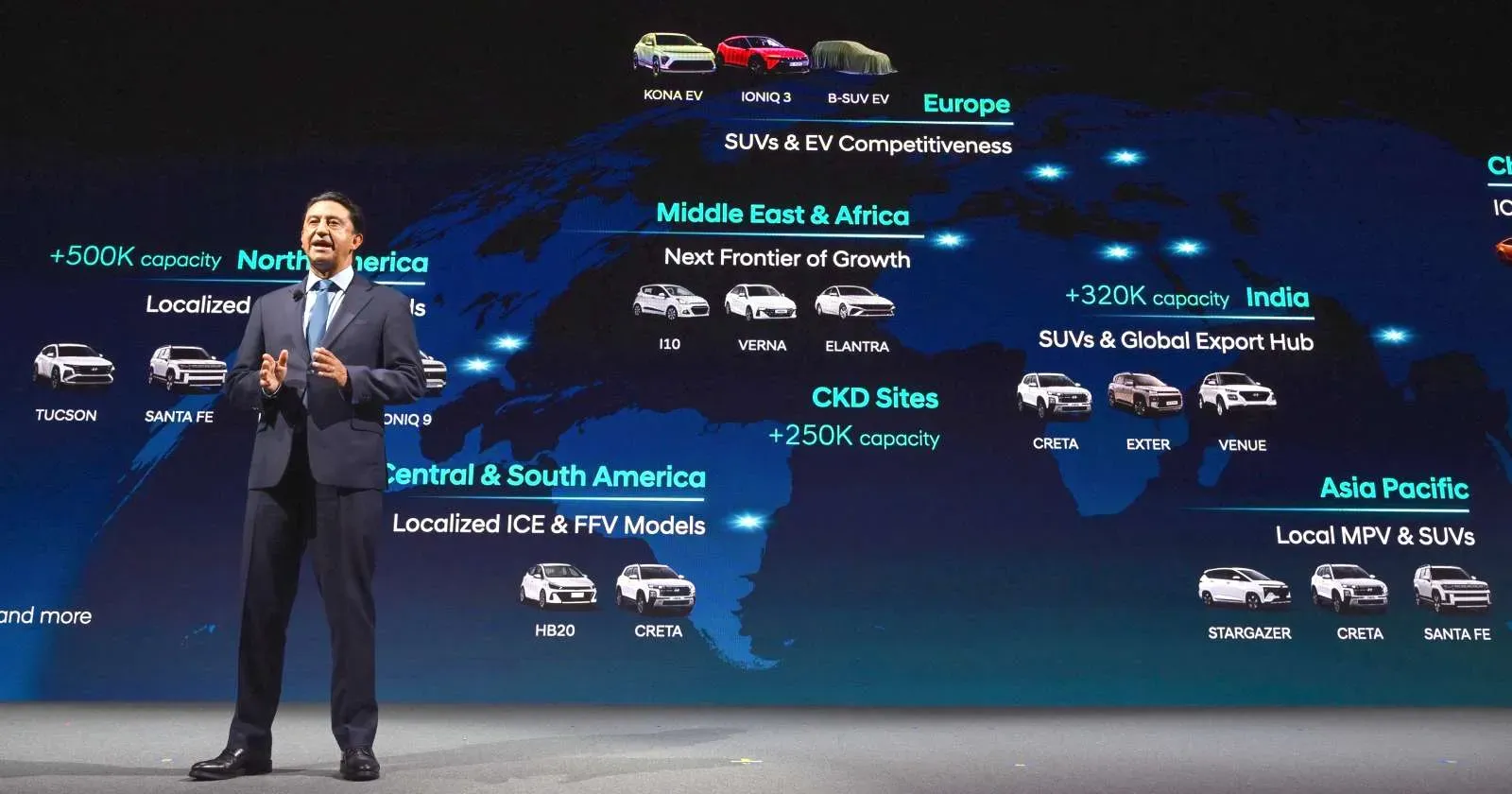
Hyundai Motor Company has laid out plans to launch 26 models in India by 2030 as part of a wider global product offensive, positioning the country as one of the group's principal manufacturing and export bases. The announcement was made at Hyundai's 2026 CEO Investor Day in Seoul on August 26, where President and Chief Executive José Muñoz outlined a roadmap covering more than 100 launches across its major markets. In addition to the 26 in India, 58 are planned for North America, 49 in South Korea, 41 in Europe, and 22 in China.
For India, the strategy centres on raising export volumes to around 30 per cent of local production by 2030, up from roughly 21 per cent in the last financial year, with the Middle East, Africa, Asia and South America identified as key destination markets. Hyundai also intends to source 90 per cent of its vehicle content locally by 2030, supported by a supplier network of more than 1,400 partners and over 900 engineers based in the country. Manufacturing capacity, currently around 1.1 million units annually across its Chennai and Talegaon plants, is to be expanded by a further 320,000 units as part of a global capacity increase of 1.27 million units.
"Our fundamentals have never been stronger. Hyundai Motor Group is the third-largest automotive group and the second-most profitable, which gives us the ability to invest while others are pulling back," Muñoz said, framing the India commitments within a broader profit-led growth strategy rather than volume alone.
The first product to emerge from this pipeline will be an all-new, locally developed electric SUV in the A-segment, due in the final quarter of 2026 with next-generation infotainment and Level 2 driver assistance, followed by a new mid-size petrol SUV. Hyundai's broader India roadmap, first detailed at its own investor day in Mumbai last October, also includes an eight-model hybrid lineup and the eventual India debut of its Genesis luxury brand.
The timing is notable given Hyundai's recent domestic performance. The company slipped to fourth place in India's passenger vehicle rankings in the last financial year, behind Maruti Suzuki, Mahindra and Tata Motors, with its market share narrowing to around 12 per cent from over 17 per cent five years ago. Exports, however, grew by more than 16 per cent over the same period, underlining the export-led emphasis of the new plan. Sales have since shown signs of recovery through 2026, aided by lower GST rates on smaller cars.
With India's passenger vehicle market continuing to expand and rivals accelerating their own electrification and export plans, Hyundai's ability to convert this roadmap into sustained market share gains, rather than exports alone, will determine whether the strategy delivers the turnaround the company is seeking.