
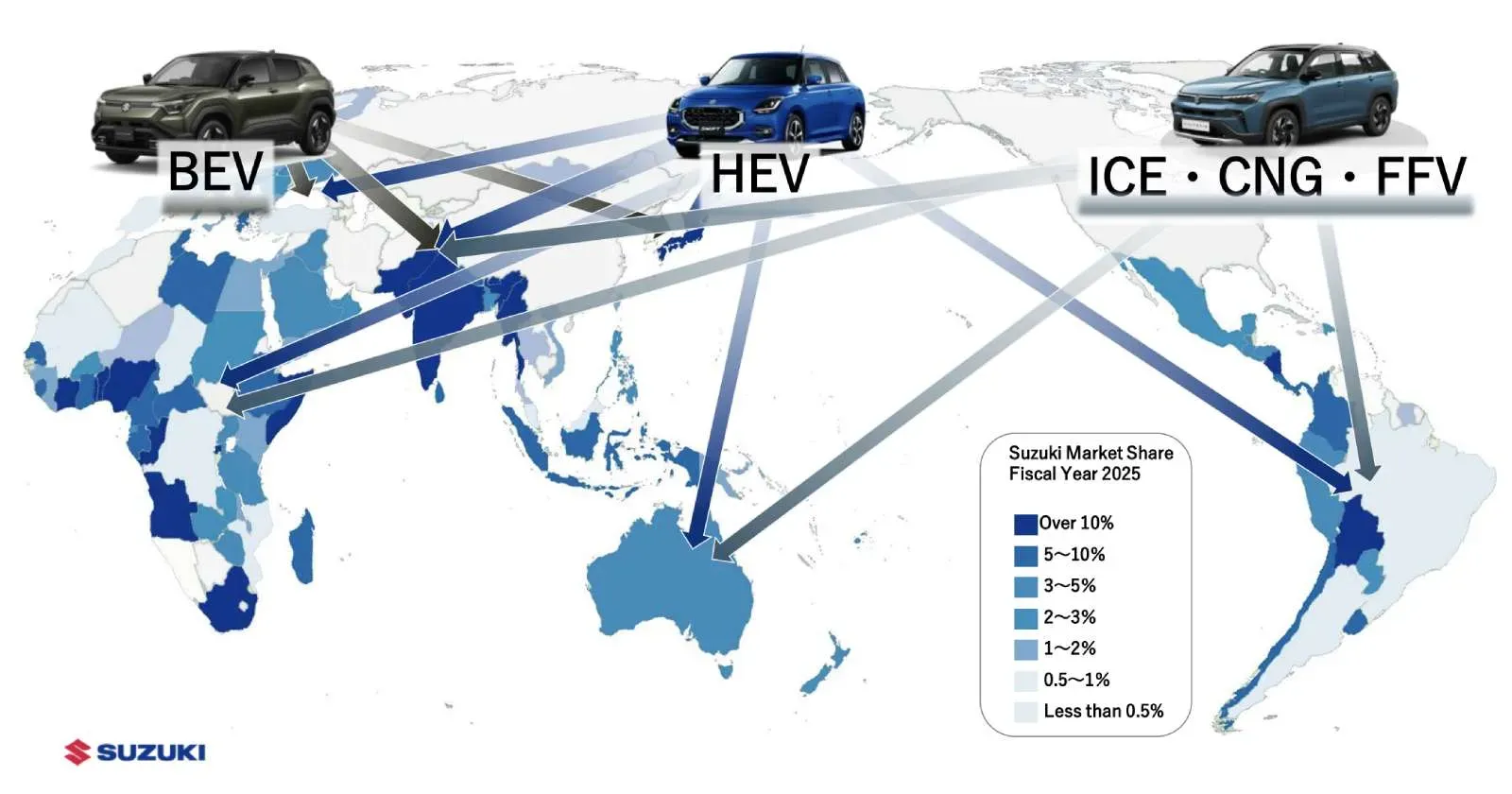
Models will be customised for each market, keeping in mind fuel types, cost structures, environmental regulations, infrastructure, raw material availability, and local preferences.



Share Post
Models will be customised for each market, keeping in mind fuel types, cost structures, environmental regulations, infrastructure, raw material availability, and local preferences.
Suzuki Motor Corporation has announced a number of major strategic initiatives at its briefing for analysts and investors, titled Technology Strategy 2026 for 10 Years Ahead, in Japan. The company is hoping to strengthen its position against increasingly tough competition from China, as well as solidify its manufacturing and product development operations across the world.
The major news for India is a new production capacity target of four million units per annum by FY 2030. This means the company not only anticipates continued growth in local demand in one of its most important markets, but also intends to strengthen India as a manufacturing and export hub. Technology developed in Japan will be leveraged and localised for multiple markets. Maruti Suzuki is already India's biggest exporter, with several models even being exported to its own home base, Japan.
The company also intends to slash development time for new models by half compared to 2020, improve manufacturing efficiency by 50 percent, and transform its processes. By improving the way it simultaneously runs engineering and manufacturing operations, and deepen its use of digital tools and modularisation, Suzuki hopes to become more competitive and agile.
Models will be customised and optimised for each major market, keeping in mind each one’s mix of different fuel types, cost structures, environmental regulations, infrastructure, raw material availability, and local preferences. The company calls this “Right × Light Mobile Tech”. Suzuki has confirmed that it will put its e Sky compact electric car into production, with this philosophy. The company claims 310 km range per charge and 97 Wh/km efficiency for the e Sky kei car.
For different markets, the “multi-pathway” product mix will include EVs, hybrids, CNG, flex fuel, and series hybrids with a new architecture codenamed Super Ene Charge. Other options include a newly developed direct-injection turbo engine, and SDV platforms for different market needs. Even within each type, factors such as battery choice will be customised for each region. Technology such as an e 4WD system can be shared between vehicle types even across categories to further improve integration.
The company intends to capitalise on the popularity and established infrastructure of CNG in India and, but notes that while today’s cars are bi-fuel, it is evaluating the market for CNG-only vehicles, which could launch in the future.
Suzuki is also touting its environmental consciousness. After recently inaugurating its third biogas plant in India, the company has said it intends to establish sustainable, local, circular resource management systems, including returning byproducts that can serve as organic fertiliser to local communities.

Maruti Suzuki Targets 4 Million Unit Annual Production Capacity in India by FY 2030
Acko Drive Team 28 Sept, 2026, 9:15 AM IST
Škoda Begins Production of Slavia Facelift at Chakan Plant
Tushaar Singh Gill 28 Sept, 2026, 7:07 AM IST
Gadkari Announces October Debut for E100 Toyota Innova
Acko Drive Team 28 Sept, 2026, 6:17 AM IST
Delhi PUC Enforcement Drive Starts From October 1
Krishna SinhaChaudhury 28 Sept, 2026, 6:15 AM IST
2026 Renault Triber Turbo Launched In India, Prices Start At ₹7.84 Lakh
Sameer Fayaz Contractor 28 Sept, 2026, 5:29 AM IST

Looking for a new car?
We promise the best car deals and earliest delivery!
